How to Age Gracefully
Friday, September 6th, 2019

Age is just a number, they tell us. But it seems we’re getting older, younger and younger. Some twenty-somethings feel as though they’re pushing sixty. How do we keep our minds and bodies in tip-top shape as we age? Are the aches, pains and ailments just inevitable? Let’s discuss how to age gracefully. Hopefully, you’ll find a new lease on life in the paragraphs that follow.
Eat A Balanced Diet
This first tip is a simple one. It’s used so frequently, it may seem trite. But the simplicity and importance of eating a balanced diet cannot be overestimated. With all the fad diets and extreme restrictions out there, balance can be hard to come by. The fads will come and go. There is no one food group that can be termed “bad.” Most everything has a benefit in moderation.

Don’t deprive yourself of good foods that you like to eat. Just eat more fruits, veggies, lean meats and whole grains. Even carbohydrates are important. It can be tempting for weight loss to eliminate carbs almost entirely. Just like carbs are important, many healthy fats are rich in Omega vitamins essential for good heart and brain health.
Some people do have to monitor carbs more closely for other health concerns. But an extreme diet can deprive your body of nutrients it actually needs. While you may experience weight loss in the short term, what’s most important? Losing weight quickly, right now? Or sustaining a healthy, balanced diet over time that will lead to a healthy weight in addition to a long healthy life.
Move Your Body
Never stop moving your body. A body at rest remains at rest. Muscles that aren’t used deteriorate over time. That can lead to your body ceasing to function and move the way it used to. Simple walking and daily stretching can do wonders for your cardiovascular and muscle health. Getting your heart rate up and releasing those feel-good endorphins fights a world of health issues.

Studies have shown that older adults who maintain active, healthy lifestyles, are 60% less likely to develop dementia. The way you treat your body affects your mind, just as the way you treat your mind affects your body. The mind-body connection is a powerful thing.
Think Youthful Thoughts
Our mental health contributes much more to our overall health than you might think. There are many who are dead long before their bodies are buried. Don’t be one of them! Live your life to the fullest. Make plans, set new goals, dream new dreams. As long as you have breath you have a purpose to fulfill. Meditation or Prayer has even shown to improve age-related memory loss. Meditation can contribute to your physical and emotional health by decreasing stress and improving mental clarity.

Invest in our youth! Mentor someone younger than you. Volunteer with after school programs or be a big brother/sister. Being around young people keeps you dialed in and aware. We tend to be most like the people we spend time around. Keeping our associations varied opens our minds to learning new things. Learning new things keeps our minds healthy.
Sharpen and challenge your mind to think. When you cease to learn, you cease to truly live. Take up a new hobby or audit a college course. An endless supply of knowledge can be found simply by taking up the habit of reading. When you continue to utilize your thinker, you guard yourself against dementia and strengthen your mind.
Wear Your Sunscreen
Your skin is your largest organ. Don’t neglect to take care of it! It’s the first thing people see and one of the biggest indicators of your age. Sun damage to your skin is a huge cause of aging. Not only does it age your skin, but you also run the risk of developing skin cancer. Skin cancer takes many lives every single year.
Never underestimate the impact of a good skincare routine, both for men and women. Begin your preventative care as young as age 25. The damage done to our skin only shows up about ten years after it occurs. Be diligent in your skincare routine and you will see a marked difference in your youthful appearance.

For women, it’s important to use a cleanser, toner, eye cream, treatment product (anti-wrinkle or brightener) moisturizer, and exfoliate regularly. Men tend to exfoliate and moisturize the lower portion of their face through shaving. They show their age on their forehead and around their eyes. Daily sunscreen in addition to an equally good skincare routine is just as important for men.
Own it!
Don’t fight the aging process, embrace it. You’ve earned your age and you have the wisdom and life experience to prove it. Every new day is a gift. You’ve been given this life and this body and it’s up to you what you do with them. Take care of yourself, whether you’re 22 or 92. None of us lives forever, but let’s live well.
A Killer Among Us: Opioid Addiction
Thursday, August 29th, 2019

We’ve seen a startling 95 percent increase of drug overdose induced fatalities in the last 10 years. Deaths caused by opioids (oxycodone, hydrocodone, codeine, morphine, etc.) account for two-thirds of that number. Many patients are ignorant of the dangers of opioids because they’ve been legally prescribed by a doctor. The danger seems less because the drugs are not illegal. However, we’ve clearly seen just how dangerous they can become.
Our best line of defense is to intervene before addiction begins. But we must also have a course of action to aid those who have already been taken over by addiction.
How Does Addiction Start?
It’s easy to think it won’t happen to you. Maybe you’re aware of the dangers and risks, but you know you’re not “that type of person.” It’s important to know that NO ONE is immune from developing a drug addiction. The likelihood of opioid addiction increases after a mere 5 days on the medication. It’s recommended that prescribed opioid use last no longer than 3 days, at the very lowest dose possible.

Addiction begins as a pleasurable experience. The drugs block pain receptors and increase endorphins, creating good feelings that you want to continue – especially when it wears off and the pain returns. As drug use continues, the body’s production of endorphins slows down, creating a “tolerance” of the drug. This tolerance means you need more of the drug to get those same feel-good feelings. Continually increasing the dosage of the drug to achieve the desired “euphoria” is what can lead to overdose.
What starts as a pleasurable experience becomes a controlling force. You no longer have a choice in the matter and your body takes over. An insatiable need for the drug becomes greater than any knowledge of the dangers involved. This is how families are torn apart and lives ruined by the epidemic of drug addiction.
How Do We End Addiction?
The simplest way to end addiction is before it starts. Lessening the number of opioids prescribed is an obvious way to keep them out of people’s hands and off the illegal markets. Taking the extra time to educate patients about proper use and disposal is imperative. Monitoring patients who have prescribed opioids for pain management is also important. There are certain indicators that reveal a greater risk for addiction, but we have to keep in mind that ultimately anyone could be at risk.

For those who are already suffering from addiction, we must provide assistance. Help is available in the form of addiction lessening medications and rehabilitation centers. We have to keep the conversation going, end the stigmas attached to drug addiction and extend a hand of hope to those who are suffering in silence.
Rehab Is Not Enough
The tragedy for those affected by addiction begins long before a life ends. Families suffer through with their loved ones, helping them through rehab, watching them suffer through withdrawal, and seeing them go back to the addiction that caused it all. One of the most common causes of overdose-related deaths occurs to people who’ve completed rehab programs. They’ve gotten clean, but try to go back to the same level of drug they were taking before. Their bodies no longer have a built-up tolerance to that concentration of drug and they die instantly from an overdose.
Rehab Centers alone are not enough. Those struggling to overcome an addiction, even after rehab, need hope. Hope for a better life, for relief from the pain, the mental battles they face, a life after addiction that can only come from the proper input. We have to stop fighting old habits and start building new ones. It’s the only way to create lasting change.

Centers like Mercy Multiplied offer a place of restoration and a bright future for women from all walks of life. They help young women struggling with addictions, victims of abuse, prostitution, unplanned pregnancy and more. They equip these women to begin again and give them the tools to prosper and flourish – all free of charge. If you know someone who needs help and thinks Mercy might be the right fit, please reach out before it’s too late. Every life is valuable. We’re losing over a hundred lives to opioid addiction every single day. We need you here. We need your story of overcoming to help those who think they can’t.
Kristy’s KleanUp is dedicated to the memory of Kristy Lee Farnham (the daughter of IAB Health Productions’ owner) who lost her life and her unborn child’s life, battling opioid addiction. Kristy was an advocate for the environment. She kept journals of her life goals and one of her major goals were being involved in a cleanup group for local parks and the community. We honor Kristy’s life by organizing Kristy’s KleanUp this year for her birthday (September 13th) and will continue to remember her every year by making Kristy’s KleanUp an annual event.
Understanding Immunization: Answering Common Questions
Wednesday, August 21st, 2019
The vast majority of Americans dutifully receive their recommended vaccinations on schedule. But some people have expressed concern about the safety and even necessity of these injections. Just as we are watchful about the food we put into our bodies, many of us are vigilant about medicines as well, opting for a more natural route when possible. The key phrase is when possible. There are times when only medication will do the job.
While its perfectly understandable to have questions and concerns about such powerful vaccines, it’s also important to have the most accurate information. Our goal is to bring you the most objective, researched information available on the subject of immunizations.
Vaccine vs. Immunization
Are these words interchangeable? Many times we hear those with concerns use the term “vaccine”, while healthcare professionals opt for the term “immunization.”
The vaccine is the actual injection of medicine, while the immunization is what occurs in your body as a result of the vaccination. We can assume medical professionals are focused on the overall goal of the injection, hence the general use of the latter term.
Are They Safe?
The most likely objection to receiving an immunization is a hesitancy about safety. As young parents with a new baby, it can be overwhelming wading through the information overload about vaccines. The CDC website is the most comprehensive place we have found for thorough, accurate information regarding the safety, ingredients, and potential side effects as well as the recommended schedule.

In addition to CDC, there is a third party organization completely separate from the government. The Health and Medicine Division (HMD) of the National Academies of Science, Engineering and Medicine is an independent, nonprofit organization. Their role is to be an unbiased source comprised of scientists who can attest to the safety or danger of particular vaccines. Read their study on some of the major vaccines that have created some concern for potential side effects. An easier to read the summary of the report’s findings can be found here. Knowing that a third party is involved to keep the public informed is very reassuring.
While the overall goal is to ensure a healthy society and eradicate diseases, a parent wants to know that their particular child will not undergo undue risk for the sake of a greater good. The CDC reassures us that the vaccines administered today are the safest they’ve ever been and are continually monitored for their safety. The truth is that with any medication, there will always be some risk of side effects. But the benefit of vaccines is believed to outweigh any potential risks.
Are Vaccines Really Still Necessary?
Our bodies are complex organisms that highly trained and skillful scientists have studied intently. The immune system specifically is extremely fascinating and intelligent. Vaccines are designed in such a way that a weakened germ or virus is injected in order that our bodies can produce “memory cells” capable of warding off any future contact with that particular illness. This creates a kind of immunity against infectious diseases.
With so many people immunized against these diseases, it only follows that they would gradually cease to occur at all. It can be easy to forget the severity of these diseases and the lives lost to them when we no longer see them in our society. Many of us have said, “Well, I had chickenpox, measles, mumps, etc. It wasn’t so bad! I was fine!” However, complications can arise from these diseases. Most of which may affect the very young, elderly or those with a weakened immune system. In these cases, eradicating the occurrence of the disease by lessening those carrying the contagions, we protect those in our community for whom these diseases could be deadly.
Why Spread Awareness?

Some people simply have a lack of awareness about their recommended vaccines. If you are a generally healthy person, you may forget to schedule a regular check-up with your Primary Care Physician. Perhaps you have a busy schedule (as so many of us do). Scheduling a time to receive a vaccine seems to rank much lower on our priority list than countless other more urgent things.
As employers, we can remedy this issue by offering Td and Flu vaccines at work. Posting recommended vaccines schedules, reminders and information in the workplace is another great way to raise awareness. Click here for a complete list of recommended vaccines for every age.
Download our free Wellness Observance Calendar for resources on promoting Immunization Awareness, as well as other health-related issues. Join us as we seek to promote Workplace Wellness and increase the health of our Nation.
Health for the Homeless
Tuesday, August 13th, 2019

It’s estimated that over half a million people in the United States are homeless. While individuals and groups such as the National Alliance to End Homelessness are working to decrease that number, these people are in dire need of good healthcare. With exposure to the elements, poor nutrition, poor sleep etc, people who are homeless are at high risk for chronic diseases and behavioral conditions. While it seems there is someone on every corner of major cities holding a sign begging for help, a few dollars in their pocket just isn’t enough. Our National Healthcare Centers are doing what they can to bring health to the homeless.
Services Provided
Health Care centers across the nation provide quality healthcare to lower income Americans. The National Health Care for the Homeless Council provides funding specifically for those most vulnerable – the homeless community. In the course of a year, health centers were able to provide care for over 1 million Americans experiencing homelessness.
In addition to primary care, they provide behavioral health, chronic disease management, dental care, laboratory services and other specialty health care. They have even provided transportation, translation and social services. The NHCH seeks to provide health care as well as be an advocate for the homeless.
Health care providers are trained in trauma care, offering individuals dignity and respect. They know their situation best and each person’s experiences have been different. The homeless are often overlooked or carelessly grouped together. Each one once had a life just like anyone of us. They are someone’s daughter, son, mother, father, friend. Some risked their lives in our armed forces, others once had status and wealth. At our local health care centers, the goal is to treat them with the same importance as anyone else, since they possess that inherent value as human beings. The NHCH believes that housing and healthcare are basic human rights and they are fighting to provide that.

What Can We Do to Help?
By supporting policies improving conditions for the homeless you can affect lasting change that will go beyond a twenty-dollar bill on any given day. Visit the National Health Care for the Homeless website to find out how you can partner with them. Outside of contributing to the cause both financially and in policy, many health centers utilize volunteers. Find out if you can volunteer at your local health center or homeless shelter.
Spread awareness! On August 15, 2019, we will observe Healthcare for the Homeless Day. Take a look at our National Wellness Observance Calendar for more information and how to get involved.
Kindness goes a long way. It’s easy to judge what we don’t understand but actually makes very little sense for us to do. Shake a hand. Learn their names and call them by it. Make eye contact and share a smile. The day we lose compassion for those less fortunate than us is the day we truly lose ourselves.

The Working Mom’s Guide to Breastfeeding
Monday, August 5th, 2019

So you just had a baby! Congratulations! You’ve made the decision whether out of desire or necessity (or both!), to return to your job after maternity leave…AND you’re breastfeeding. Well, you should know, breastfeeding while going back to work has its challenges. But it is very possible if you’re prepared with the right knowledge and expectations. In honor of World Breastfeeding Week (August 1-7), we want to share some tips to help you keep a healthy supply and continue your breastfeeding journey for as long as you’d like.
Balance – Banish the Guilt!
It seems unfair to be forced to choose between what’s best for your baby and what’s best for your career or finances. We want to help you feel like that’s not a choice you have to make! While keeping up with work and doing just as great a job as always is important, your health and the overall health of your baby should never be what suffers.

You’ve now entered into a new role of motherhood which requires self-sacrifice, multi-tasking, and the constant awareness that part of your heart now exists outside of your body. Be prepared to give yourself lots of extra grace and take the pressure off of yourself. It may take some time to get back to the level of productivity you once had. The commitment to pumping while at work is a significant one. Commitment is what it takes to make it happen! Give yourself a goal to reach. Maybe you want to try it until your baby is 3 months old, six months, or go for the full year! Take it a little at a time, embrace the quiet moments and extra breaks that pumping at work allows for you. If other people can take smoke breaks every couple of hours, you can take that time guilt-free to produce nourishment for your new baby.
Invest in Quality Equipment
Who says your productivity has to slow down, just because you have to pump? Technology has advanced so much in recent years. It’s possible to pump completely hands free while on your commute or even at your desk while responding to emails. It’s your world, mama, make it work for you! Many insurance companies will even provide a quality pump at no extra expense. Make sure to research all your options and find out what’s worked best for other working moms you know.
Keep Up Your Supply
One of the biggest challenges, outside of frequent pumping, can be keeping up a good supply. Being physically away from your baby for extended periods of time can signal your body to slow down its production of milk. Here are some ways to guard against that and keep up a supply to meet your baby’s ever-changing demands.
- Get enough rest
- It’s so important that in order for our bodies to perform at their optimum capacity, they have the rest they need to recuperate and repair. Give yourself a regular, soothing bedtime routine and stick to it. Just like your infant needs that time, so do you. It may not always be feasible, but it should be the goal. Three out of five days a week is better than none at all. Take a small snooze at your desk or in the car on your lunch break. Even if all you do is close your eyes and meditate for 10 minutes, it allows your brain and body a chance to rest.
- Eat a healthy diet
- Now is not the time to cut calories or skip breakfast. Your body NEEDS food for fuel to produce the proper nutrition for your baby as well as for you. You’re still eating for two and may find yourself even more ravenous than you were during pregnancy. Keep nutritious snacks full of fiber and protein close at hand at all times. Eat small meals every couple of hours and never skip a meal. Planning ahead is key, especially for your busiest days.
- Stay Hydrated
- If you’ve already begun to breastfeed you know how incredibly parched you become when you sit down to feed your baby. Keep a large, insulated water bottle with you at all times. Don’t like the taste of water? Try an infused water recipe or other added flavor packets (best to do ones without any added sugar). Staying hydrated is one of the MOST important aspects of keeping up a healthy milk supply.
- Keep photos of your baby close
- It can be difficult for your milk to let down when your baby is not close by. Keeping photos of your child around you, especially when pumping, can help keep your mind and therefore your body on the task it still needs to perform. Imagining your baby in your arms can also aid in your production of milk. Imagination is powerful. Use it to your advantage!
- Good communication with Caregiver
- Set up an arrangement with your child’s caregiver to communicate with you when your child feeds and how much they consume in one feeding. Aim to make sure that you are pumping at approximately those same times and replenishing the same amount in your pumping sessions. You may need an additional pumping to make up for the full amount you baby needs since a baby is always more efficient at extracting milk than a pump. Use your own best judgment.
- RELAX
- Take a deep breath. Let it out slowly. You’ve got this. Many moms have done it before you and they faced similar struggles. You’re doing a great job. Set the stress aside. Listen to some calming music or chat with a coworker who may understand your current season of life. Any way to alleviate some stress will help your body perform at its best. On the other hand, stress and elevated levels of cortisol produced by stress can create a whole world of health issues. If you find that the pressure to succeed at breastfeeding while going back to work is just too much, it is totally okay to stop. Do what you find works best for YOU.

Adjust Your Baby’s Schedule
There are lots of babies who may wake up at 8 am for the day and are back in bed for the night by 8 pm. If you work from 8 am – 5 pm or have a long commute, you may not see your baby much at all during the day. That can be emotionally difficult as well as taking a toll on your supply and breastfeeding relationship. Take measures to slowly adjust your baby’s schedule. Perhaps you can shift it a little later so that you have more hours together in the evenings before bedtime.
Night wakings can be especially difficult for a mom who works outside the home. Not only are you getting less sleep from waking up to feed your baby, but you also really crave that time to hold, feed and bond with your baby. It feels like you must choose between your basic need for sleep and the instinctive desire to love and care for your child. Consider safe options for co-sleeping (baby beds that attach to the side of your bed are a great option!). Studies have found increasing benefits for better sleep and attachment between parents and children who co-sleep. Even with decreased time together during the day, those night-time feeds can do wonders for your milk supply and the bond with your baby.
Keep the Proper Perspective
It’s so important to keep things in the proper perspective during this time. As a mom, you’ll have plenty of opportunities to feel like your failure or success as a mom rides on this one thing. The reality is that your baby needs to be fed, whatever that may look like. Your desire to do what you feel is best for your child is admirable and praiseworthy. It’s what makes you a great mom!
Taking care of yourself also makes you a great mom. The breastfeeding relationship should always be mutually beneficial. When it stops being beneficial to one of you, (typically that happens for mom first, unless the supply has dipped too low) it may be time to reevaluate your options.
Stay in open and honest communication with your own personal “village”: your spouse, pediatrician, lactation consultant, mom, other seasoned mom friends. Lean on your support system and let them help you. Never forget that your experience is yours. It doesn’t have to look like someone else’s to be good. Keep going and hang in there! These days go by just as quickly as they say they do.
2017 Wellness Observance Calendar
Monday, October 10th, 2016
January 2017
Cervical Health Awareness Month
National Birth Defects Prevention Month
National Blood Donor Month
National Glaucoma Awareness Month
Jan 30, 2017 World Leprosy Day
February 2017
American Heart Month
AMD/Low Vision Awareness Month
National Cancer Prevention Month
National Children’s Dental Health Month
Feb 03, 2017 National Wear Red Day 2017
Feb 04, 2017 World Cancer Day 2017
Feb 09, 2017 Toothache Day 2017
Feb 28, 2017 Rare Disease Day 2017
March 2017
Workplace Eye Wellness Month
Brain Injury Awareness Month
National Developmental Disabilities Awareness Month
National Kidney Month
National Nutrition Month
Mar 05, 2017 Multiple Personality Day 2017
Mar 09, 2017 World Kidney Day 2017
Mar 21, 2017 World Down Syndrome Day 2017
Mar 24, 2017 World Tuberculosis Day 2017
April 2017
Alcohol Awareness Month
Sports Eye Safety Month
National Child Abuse Prevention Month
National Donate Life Month
Stress Awareness Month
National Minority Health & Health Disparities Month
Apr 02, 2017 World Autism Awareness Day 2017
Apr 07, 2017 World Health Day 2017
Apr 17, 2017 World Hemophilia Day 2017
Apr 25, 2017 DNA day 2017
Apr 25, 2017 World Malaria Day 2017
Apr 28, 2017 World Day for Safety and Health at Work 2017
May 2017
Employee Health and Fitness Month
Healthy Vision Month
Asthma and Allergy Awareness Month
Better Sleep Month
National Mental Health Awareness Month
National Stroke Awareness Month
May 02, 2017 World Asthma Day 2017
May 05, 2017 World Hand Hygiene Day 2017
May 06, 2017 International No Diet Day 2017
May 08, 2017 World Red Cross and Red Crescent Day 2017
May 12, 2017 Chronic Fatigue Syndrome Day 2017
May 12, 2017 International Nurses Day 2017
May 18, 2017 World AIDS Vaccine Day 2017
May 31, 2017 World No Tobacco Day 2017
June 2017
Men’s Health Month
Cataract Awareness Month
Cataract Awareness Month
National Great Outdoors Month
National Safety Month
Migraine and Headache Awareness Month
Jun 04, 2017 National Cancer Survivors Day 2017 USA
Jun 08, 2017 World Brain Tumor Day 2017 World
Jun 14, 2017 World Blood Donor Day 2017 World
Jun 18, 2017 Autistic Pride Day 2017 World
Jun 25, 2017 World Vitiligo Day 2017 World
Jun 26, 2017 International Day against Drug Abuse and Illicit Trafficking 2017
July 2017
Fireworks Safety Month
UV Safety Month
National Park and Recreation Month
Jul 28, 2017 World Hepatitis Day 2017
August 2017
Children’s Eye Health & Safety Month
National Breastfeeding Month
National Immunization Awareness Month
September 2017
Prostate Cancer Awareness Month
Baby Safety Awareness Month
National Childhood
Obesity Awareness Month
National Cholesterol Education Awareness Month
National Sickle Cell Disease Awareness Month
Sep 10, 2017 World Suicide Prevention Day 2017
Sep 28, 2017 World Rabies Day 2017
October 2017
“Talk About Your Medicines Month”
Healthy Aging Month
Domestic Violence Awareness Month
National Breast Cancer Awareness
Month National Bullying Prevention Month
National Depression and Mental Health Screening Month
Oct 02, 2017 Child Health Day 2017 USA
Oct 03, 2017 Virus Appreciation Day 2017
Oct 10, 2017 World Mental Health Day 2017
Oct 15, 2017 Global Handwashing Day 2017
Oct 16, 2017 World Food Day 2017
Oct 20, 2017 World Osteoporosis Day 2017
Oct 22, 2017 International Stuttering Awareness Day 2017
November 2017
American Diabetes Month
National Healthy Skin Month
National Alzheimer’s Disease Awareness Month
National Epilepsy Awareness Month
Nov 12, 2017 World Pneumonia Day 2017
Nov 14, 2017 World Diabetes Day 2017
Nov 17, 2017 World Prematurity Day 2017
December 2017
International AIDS Awareness Month
National Drunk and Drugged Driving Prevention Month
Safe Toys and Gifts Month
Dec 01, 2017 World AIDS Day 2017
Dec 03, 2017 International Day of People with Disability 2017
January 2018
Jan 30, 2018 World Leprosy Day 2018
February 2018
Feb 02, 2018 National Wear Red Day 2018
Feb 04, 2018 World Cancer Day 2018
Feb 09, 2018 Toothache Day 2018
Feb 28, 2018 Rare Disease Day 2018
March 2018
Mar 05, 2018 Multiple Personality Day 2018
Mar 08, 2018 World Kidney Day 2018
Mar 21, 2018 World Down Syndrome Day 2018
Mar 24, 2018 World Tuberculosis Day 2018
April 2018
Apr 02, 2018 World Autism Awareness Day 2018
Apr 07, 2018 World Health Day 2018
Apr 17, 2018 World Hemophilia Day 2018
Apr 25, 2018 DNA day 2018
Apr 25, 2018 World Malaria Day 2018
Apr 28, 2018 World Day for Safety and Health at Work 2018
May 2018
May 01, 2018 World Asthma Day 2018
May 05, 2018 World Hand Hygiene Day 2018
May 06, 2018 International No Diet Day 2018
May 08, 2018 World Red Cross and Red Crescent Day 2018
May 12, 2018 Chronic Fatigue Syndrome Day 2018
May 12, 2018 International Nurses Day 2018
May 18, 2018 World AIDS Vaccine Day 2018
May 31, 2018 World No Tobacco Day 2018
June 2018
Jun 03, 2018 National Cancer Survivors Day 2018 USA
Jun 08, 2018 World Brain Tumor Day 2018
Jun 14, 2018 World Blood Donor Day 2018
Jun 18, 2018 Autistic Pride Day 2018
Jun 25, 2018 World Vitiligo Day 2018
Jun 26, 2018 International Day against Drug Abuse and Illicit Trafficking 2018
July 2018
Jul 28, 2018 World Hepatitis Day 2018
September 2018
Sep 10, 2018 World Suicide Prevention Day 2018
October 2018
Oct 01, 2018 Child Health Day 2018
Bring Nutrition & Wellness Awareness to The Workplace
Thursday, March 3rd, 2016
According to scientific research, workplace nutrition programs have a great benefit on the well-being of every employee and are meant to reduce the healthcare costs and turnover as well as any potential disability. Aside from that, they are the trigger to better productivity and a vital link in the overall health of the company.
Are you reinforcing nutrition awareness at your company? If not, here is how to do it in 5 simple ways:
- Promote Nutrition Workshops – Providing workshops on Nutrition is a great way to bring awareness to employees. Workshops can range from “How to Read Food Labels” to “How to Grocery Shop”. By promoting the workshops, you are bringing healthy nutrition awareness to every employee. The employees that don’t choose to attend the workshops will still think about their nutritional habits daily as they see the workshop promotional material and announcements. Search Nutrition Workshops
- Provide Healthy Snacks – Offer a range of healthy snacks that contain some protein, some fat, and complex carbohydrates. The standard office snack food fare such as cookies, chips, and sodas are high in simple sugars that cause a spike in energy when eaten followed by the inevitable “sugar crash” that leaves people feeling tired and unmotivated. Read more
- Corporate Healthy Cook-Off – Promote employees to join a healthy cook-off. Designate judges for your cook-off and have employees submit tastings of their most healthy, best-tasting recipes. Winner(s) receives a ribbon or prize and all recipes are posted for employees to enjoy.
- Provide a Listing of Healthy Restaurants – Post or email your employees a list of restaurants in the area they dine at for lunch and/or dinner. By providing healthy dining choices that employees may not be aware of, you offer an alternative to the unhealthy fast food most have become accustomed to.
- Post Nutritional Facts – By posting nutritional facts throughout your office, you bring awareness and resolutions to employees that may not have known otherwise. There are many free facts online that can easily be printed and posted for employees. As employees see this information, they are more apt to make small changes based on visual knowledge. Search Facts
In the end, nutrition and workplace wellness are both aspects of future awareness and care for your employees. They are a rising trend, but also a bridge to better productivity and well-being for everyone in your workspace – including yourself.
ROI Versus VOI – And The Value of Corporate Wellness
Thursday, March 3rd, 2016

Many times we have heard people saying ‘What’s your return on investment (ROI) on that?’ or ‘How much are we going to make and will it be profitable?’. The principle of ROI literally means a return on investment, or in other words – ensuring that your investment receives the same amount of money back – or even more.
However, the value on investment (VOI) has been a trending topic over the past few years and one definitely worth exploring. The concept of VOI was first introduced by Gartner, one of the pioneer companies in information technology research. Value On Investment (VOI) is best defined as all the intangible assets that contribute to an organization’s performance.
From the prism of corporate wellness, VOI often collides with ROI. In fact, the value of investment represented by VOI includes all the knowledge and processes as well as organizational structure, which is very often more critical to an organization than simply put – the budget spent and the expectations on it.
Let’s face it – investing funds in a project certainly comes with a responsibility. Therefore, ROI is an important aspect of corporate wellness nowadays. However, ensuring that the funds invested have a certain value, intangible benefits as well as increase productivity to result with a higher ROI – is the missing link that many companies fail to understand when evaluating their investment.
So, what does Value On Investment actually mean?
It means more than just a budget that is set. It means understanding the real value of something and defining the benefits of that investment. In other words, it refers to:
- Value of information – Is the information used for the investment relevant?
- Value of initiative – Is there a business voice standing behind all the actions within a company?
- Value of impact – Does the investment guarantee impact that will benefit the marketplace?
- Value of influence – Is the company that invests influential in the community?
- Value of Instruction – Are the processes within industry-appropriate and meet the standards set by the government?
- Value of Interaction – Will the members be able to make connections, share information and learn the best practices?
- Value of Insights – Is the investment guaranteed to make every member gain valuable knowledge?
- Value of Integration – Is the value of investment meeting the goals of the company?
As you can probably see, VOI comes with a lot of principles, which every company needs to understand before partaking in an investment. It is definitely one of the rising trends to incorporate wellness and the one that, along with ROI, acts as the backbone value of every investment.
IAB Health Productions, LLC offers FREE wellness program planning services for organizations. With a diverse network of thousands of providers and our wide range of online tools and experts, we can guarantee that each program is designed to meet the individual needs and desires of our valued clients.
Planning a Successful Health Fair
Monday, January 11th, 2016

Click to download pdf Guide to Planning a Successful Health Fair
A company health fair is a wonderful way to encourage healthy options for your employees. Creating an event that is educational, well attended and supportive of long-term health management can be achieved by following the recommendations in this guide.
IAB Health Productions, LLC offers FREE online tools to manage every aspect of your health fair while keeping your personal contact information private. Click here to begin scheduling your event.

Planning Your Event
Start planning your health fair at least five months in advance. A planning team can be assembled for the event to assist with the tasks. This may be the human resources department, or it can be representatives from various areas of the company. Health Fairs are better attended when various department managers are involved in the planning, as they are more apt to promote and encourage their staff to participate.
Executive Leadership
It is critical for leadership to support the health fair and encourage employees to participate. Having memos sent out from executive staff members reminding the employees about the event is imperative for participation. It is also great to have C-level staff members at the health fair mingling with both the vendors and the employees.
Kick-off Programs
Health fairs are also a great time to introduce your employees to long-term health programs that are scheduled within the company. Long-term initiatives can include employee paid programs such as weight loss programs, smoking cessation programs, chair massage services, stress management classes, walking programs, etc.
Theme
You can allocate a theme for your event and encourage participating vendors to support this theme at their table for increased engagement. Themes can revolve around health-related topics such as a season, a charity, or a popular book. Here are some examples you may like to consider below.
- Hike Your Way To Better Health – Encourage employees to wear hiking clothes and bring backpacks. Encourage vendors to bring water bottles, trail mix, nature bars
- Don’t Gamble with Your Health – Encourage Vendors to set up a casino-style booth and wear visors.
- Valentine’s Day – Hearts Matter – All Vendors have hearts on their tables.
- Spring – Spring into a New You – Vendors bring flowers
- You always had the POWER – Vendors dress up or bring items related to the Wizard of Oz
Timing
When determining the best time of year to host your event, consider company peak periods and facility needs during these times. Timing your health fair during slow times can increase morale and participation. Therefore it may be wise to consider a slow period. If space is an issue, you may also want to consider a warmer season, so you could have the option of hosting your event outside. Schedule the event around the time that you feel your employees would be most available to visit the event to increase the chance of high attendance.
For the purposes of attracting qualified vendors to display in your health fair, it is not recommended to hold the fair for longer than 5 hours, nor is it suggested to have your health fair start before 9 AM and end at 5 PM. Below is a good outline for the length of your health fair.
• Up to 50 employees (2 hours)
• 100-200 employees (3 hours)
• 200+ employees (4 hours)
Multiple Locations
If your company has multiple locations, you may need to plan your events on separate days so you can have vendors attend all events. In the circumstances that your locations are spread out, you will need to duplicate all the instructions below for each event. If the other locations are too small to support a health fair, request additional materials from your vendors to make available to the employees at the other locations.
 Venue
Venue
When selecting your venue, you will need to consider space and electrical access. It is also important to take into account what size tables you have for the vendors to display their information (6ft or greater is suggested) and how many will fit comfortably in this space. One foot or greater is suggested between vendors and a minimum of three feet walking space for your employees with all fire exits clear works well.
You may want to take into account that your vendors will need extra floor space and electric as they may provide screenings and video displays. When considering Chair Massage, Vision, Spinal screenings along with flu shots and biometrics, remember that each of these will require space for both the vendor’s display and the employees. Many vendors use tall stand-up displays that will block traffic and event visuals. Request that all vendors place their banners behind their booth and with this in mind, give the vendor 3ft behind their booth for their supplies, chairs and movement.
It is estimated that 30% of your vendors will need access to electric, so when designing your floor plan, take into account the total number of tables you can accommodate and give two-thirds access to electric.
Inviting Providers
Insurance Providers
It is important to remember that your insurance providers are your employee health partners. A health fair is a great way for your employees to interact with their insurance providers to learn more about their benefits and the health resources available to them through their insurance plans. Decide what insurance providers you would like to have at your health fair and what information and giveaways you would like to have them bring.
Wellness Providers (vendors)
The vendors that you decide to have at your Health Fair will be the cornerstone of your event. When selecting the educational topics and vendors that you consider appropriate for your health fair, you may want to consult with your insurance broker or provider to get a utilization report lending information to the health risk of your employees.
Keep your event information and fun by including information that employees would not usually have the opportunity to understand like Acupuncture, Water Filtration, Reiki and, most importantly, Mental Health. You may also use a national online listing of vendors to help arrange what is best for you.
All Providers should be sent an invitation to participate in your event 60 – 90 days before the event date. You can invite vendors using a free online web tool, via email, via phone, or both. You will need to provide the following information in your invitation.
- Event Name: Theme Name or “Company” Health Fair
- Event Overview: Tell the vendors about your event. Explain your theme; focus on how you will promote the attendance of your employees. Let them know if you will be providing the employees and or them food or any special promotions to encourage participation.
- Event Date: From (“Start Time” to “End Time”) Allow 1 hour before the event start for vendors to set up.
- Number of Employees that will be invited to the event: Usually the total number of employees at your location
- Anticipated Attendance: This is needed by the vendor so they can prepare materials and giveaways for employees
- Location of Event: Provide Address and area event is to be held (conference room, outside parking lot, cafeteria)
- Any Certificate of Insurance or Waivers that will be required
- Event Point of Contact name and email address
- Ask vendors to bring a raffle prize for an overall raffle for employees
Vendor RSVPs
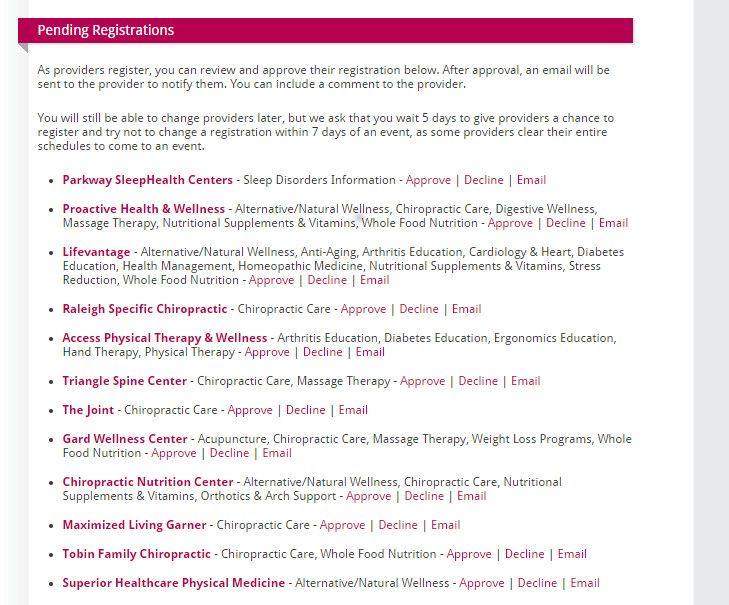
Vendors will need to RSVP and provide you with the information listed below. IAB provides an online registration tool for vendors that allows employers to review the requesting vendor’s information before accepting their registration. This gives employers a broad range of prospective vendors to choose from.
- Company Name
- Representatives names
- Electric Needed
- Linen Needed
- Extra Floor Space Needed (how much)
- Providing Screenings/services
- Copy of any COI or Waiver (if needed)
- Employee Communication
Employee Communication
Save the Date
60 – 90 days before the event it is suggested to send a “Save the Date” out to your employees so they can put the event on their calendar. This can be emailed and posted throughout your facility near high traffic areas to ensure maximum exposure to the information. Offer suggestion boxes in various places for employees to suggest creative ideas or vendors. A survey or hints to win prizes at the event can also be contained in this posting.
Event Announcement
30 days before the event it is suggested to send an Event Announcement to employees giving full details about the event. It should include the following:
- Event Title and Theme
- Event date
- Event time (start-end)
- Event location
- Listing of vendors
Preparing the Venue
Two weeks before the event, all vendors and their booth requirements should be finalized. Each of the below items will now need to be considered and ordered for your event. IAB’s free online tool provides employers with a detailed listing of each registered vendor’s needs.
Vendor Booths:
- Number of Tables you will need (rent if needed)
- Number of Linens you will need (tables will need covers)
- Number of Vendors that require electrical access (extension cords may be needed)
- Event Requirements
You will need a few items on hand for your event. Below is a list of suggested items you will need to have prepared for your event ahead of time. - Pens
- Tape
- Scissors
- Extension Cords
- Raffle Ticket Basket
- Raffle Tickets – Provide a way for employees to enter a raffle for attending the event. Vendors will bring raffle prizes.
- Event Guides– It greatly helps to provide your employees with a listing of each vendor with their contact and services information
- Table Tag Displays will be used for placing your vendors; those will need to be printed and prepared once your list is complete.
Room Layout

Design a floor plan placing each vendor in the room based on the vendor’s booth needs along with your room & table size. Make sure you have accounted for a check-in table and with a familiar staff member to greet each employee.
Try to keep all vendors in one room. If screening rooms are used, there should be a check-in table or proper signage to direct the traffic. This helps with the flow of employees and allows you to keep an eye on how the event is going. When placing vendors’ tables, try to keep vendors that provide similar services separately. As tempting as it is to put them together, it does cause friction and competitive nature among providers, which could make it unpleasant for everyone.
Vendor Confirmations
One week before the event, communication should be made with all participating vendors to provide them with final details. Provide details such as where they should unload their car and where they are expected to park after that. Remind them to bring their raffle prize and of the set-up start time. Make sure to provide vendors with a contact and phone number they can reach should they get lost on the way to your event or need to cancel for an unforeseen reason. IAB automates this for you.
Employee Reminders
One day before the event, send a final event promotion to your employees. Make sure the venue is set-up and ready to go for the vendors if you have an early event.
Event Day
Have a minimum of two staff members to assist with the event at all times, also make sure you have the room ready for vendors 1 hour before the event start time. This will give you and your vendors plenty of time to get in and safely set up before your employee’s arrival. Some vendors will arrive early and some will be late. This is to be expected and considered on the event day, so please keep this in mind.
- Have a welcome table for HR/Wellness team. Items to have on the welcome table:
- Raffle prizes (IAB requires all participating vendors to provide a raffle prize)—should be collected from each vendor and placed on welcome table for employees to see as they enter the event
- Raffle tickets
- Raffle ticket entry container
- Pens
- Wellness Guides (if applicable)—Handed out to the employees as they enter the event
Vendor Arrival
As vendors arrive, greet each one and direct them to their booth. Let them know where the restrooms are and if any refreshments are available to them. Many vendors will want to make small talk with you as you are trying to greet and accommodate other arriving vendors. Let them know you will be around during or after the event to speak with them in more detail.
Employee Arrival
Have two staff members at the check-in table to greet the employees as they arrive. It is highly suggested that a C-Level staff member also is present at your event to show employees their endorsement. Staff members can rotate between checking in employees and checking on the vendors.
Event Conclusion
As vendors begin to pack up and leave, take the time to thank each one for their time at your event
7 Holiday Inspired Ideas for a Healthier Workplace
Wednesday, January 6th, 2016
With decadent dishes, excessive drinks and parties galore, the holidays are the toughest time of year to maintain a healthy lifestyle. Help keep your employees mindful this holiday season with these tips for healthier ways to keep things festive.
1. Share holiday food facts: Make the nutrition information for favorite holiday dishes readily available to your employees by printing them off on index-sized cards that they can take with them. Be sure to include portion size, calorie, fat, and sugar content. Reinforce nutrition awareness in company newsletters and other communication. You can get the nutrition information for popular holiday dishes here.
2. Offer healthier alternatives: You’re employees will probably be negatively shocked by the calorie content in some of their favorite dishes, so this is a great opportunity to introduce healthier options. Let them know about simple ways to lighten up some of the traditionally heavier holiday dishes. Or an even better option is to provide these healthier alternatives at your holiday potluck or party. Engage employees by encouraging them to bring and share their own healthier recipes.
Bonus tip – Make things even more fun by having your employees vote for the best revamped healthy dish at the potluck and provide the winner with a holiday prize.
3. Keep portion size in mind: Provide your employees with visual examples of proper portion size. Share this Thanksgiving portion guide with employees and pre-cut things like pies and casseroles into proper servings before calling them to dig in at any seasonal office parties.
4. Provide flexible break times: With daylight hardly sticking around past quitting time, many people get even less exercise than usual. Encourage breaks during lunch or other daylight hours to keep your employees focused on outdoor activity.
5. Organize exercise events: Try to motivate your employees to move more by focusing on group exercise events, such as walks before or after work or yoga sessions. Lead by example by having higher-ups at your company participate in local holiday-themed events, such as a Turkey Trot, and encourage all employees to join as well.
6. Consider gym reimbursements or discounts: Check out nearby gyms and see if you are able to offer your employees a corporate discount or reimbursement on their gym fees.
7. Reach out to your health fair vendors: Do you give out holiday gift bags to your employees and have hosted a health fair this past year? Incorporate elements of wellness by reaching out to your favorite health fair attendees or current providers for samples that you can pass on to your employees.
More Resources for Holiday Health –
Healthy Holiday Recipe Archive
Will you be trying any of these tips with your employees this holiday season? Have anything to add to the list? Let us know in the comments!