Suicide Prevention Awareness Month: Connection, Hope and Support Can Save Lives
Monday, August 31st, 2026

Every September, Suicide Prevention Awareness Month provides an opportunity to bring an often difficult subject into the light.
It is a time to remember those whose lives have been lost to suicide, support people who have struggled with suicidal thoughts, acknowledge the families and communities affected, and remind one another that help, treatment and hope are available.
Suicide prevention is not only the responsibility of mental health professionals. Friends, family members, coworkers, managers and communities can all play a role by creating stronger connections, recognizing when someone may be struggling and helping people reach appropriate support.
Sometimes the most meaningful first step is simply letting another person know:
I see you. I care about you. You don’t have to face this alone.
Know the Warning Signs
Emotional distress does not always look the same from one person to another. Someone may appear sad and withdrawn, while another person may seem angry, anxious or unusually restless.
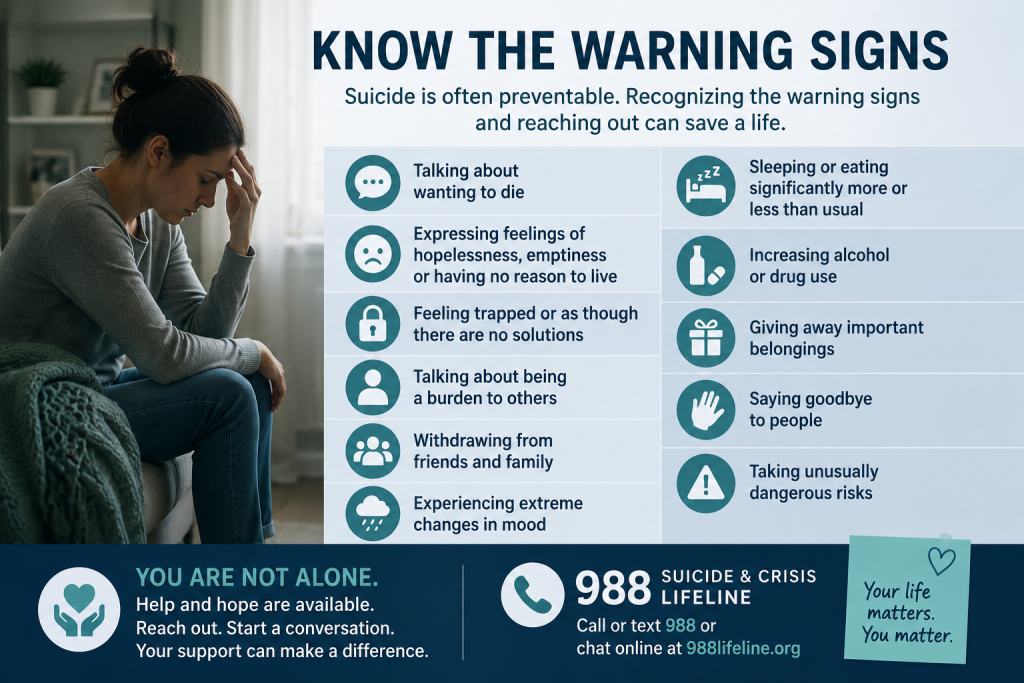
The National Institute of Mental Health identifies a number of warning signs that can indicate someone may be experiencing suicidal thoughts. These can include:
- Talking about wanting to die
- Expressing feelings of hopelessness, emptiness or having no reason to live
- Feeling trapped or as though there are no solutions
- Talking about being a burden to others
- Withdrawing from friends and family
- Experiencing extreme changes in mood
- Sleeping or eating significantly more or less than usual
- Increasing alcohol or drug use
- Giving away important belongings
- Saying goodbye to people
- Taking unusually dangerous risks
A particularly important concern is a new or significant change in someone’s behavior, especially when it follows a painful loss, major life event or other difficult experience.
Knowing the warning signs doesn’t mean we should try to diagnose someone. It means we can recognize when it may be time to reach out.
Don’t Be Afraid to Ask
Many people worry that asking someone whether they are thinking about suicide might somehow put the idea into that person’s mind.
Research does not support that fear. According to the National Institute of Mental Health, asking directly about suicidal thoughts does not cause or increase them. A direct, caring question can instead help identify someone who needs support.
If you’re concerned about someone, don’t feel as though you need to find the perfect words.
Start a conversation.
Tell the person you’ve noticed that they don’t seem like themselves and that you’re concerned about them. Listen without judgment and allow them to talk.
If necessary, ask directly whether they are thinking about suicide.
The important thing is to approach the conversation with compassion rather than fear, criticism or embarrassment.
How to Support Someone Who Is Struggling
When someone shares that they are struggling, our natural instinct may be to immediately try to fix the problem.
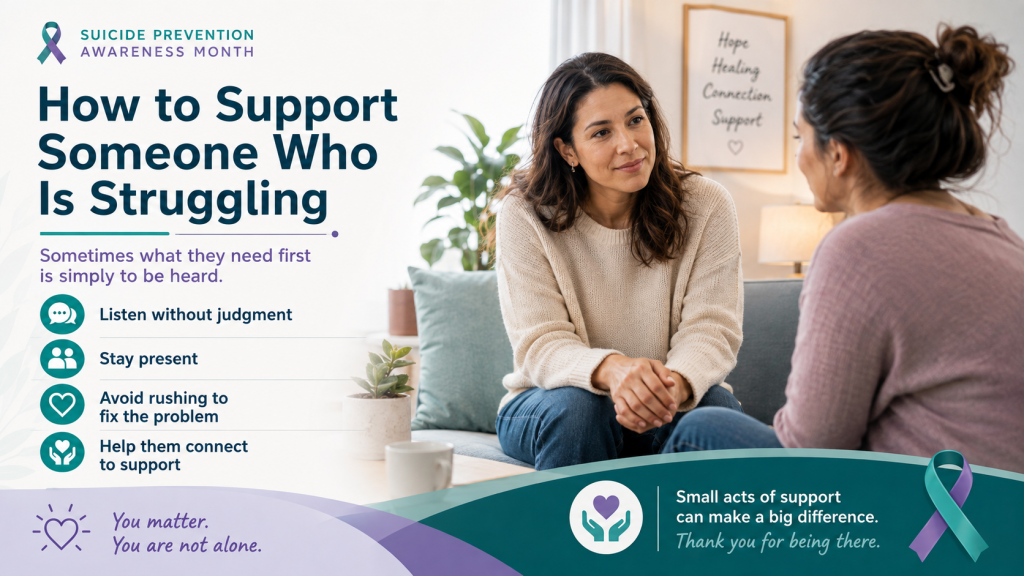
Sometimes what they need first is simply to be heard.
Give the person your full attention. Listen without minimizing what they’re feeling or immediately comparing their situation to someone else’s.
Avoid responses such as, “You have so much to be grateful for,” or “Other people have it worse.”
Instead, acknowledge that they are hurting.
Stay present. Ask what they need. Encourage them to connect with a mental health professional, physician, Employee Assistance Program, crisis counselor or another trusted source of support.
If someone tells you they intend to end their life, do not leave them alone and do not promise to keep it secret. Seek immediate help.
And don’t underestimate the importance of following up later.
A text message, phone call or simple question such as “How are you doing today?” can remind someone that they haven’t been forgotten.
Connection Matters
Human beings need connection.
Feeling supported by family, friends, coworkers and community can help protect emotional well-being. The CDC identifies social connectedness as an important protective factor and encourages communities to create opportunities that reduce isolation and strengthen relationships.
That doesn’t always require a formal program.
Invite someone to lunch.
Call the friend you haven’t heard from lately.
Check on a coworker who’s been unusually quiet.
Invite a neighbor for a walk.
Include someone who seems to be on the outside of a group.
Small moments of genuine human connection can matter more than we realize.
Support Mental Health at Work
Because adults spend so much of their lives working, the workplace can play an important role in supporting mental health.
Work-related stress can affect an employee’s well-being both on and off the job, and managers and supervisors can help create healthier environments by addressing unnecessary workplace stress and making support easier to access.
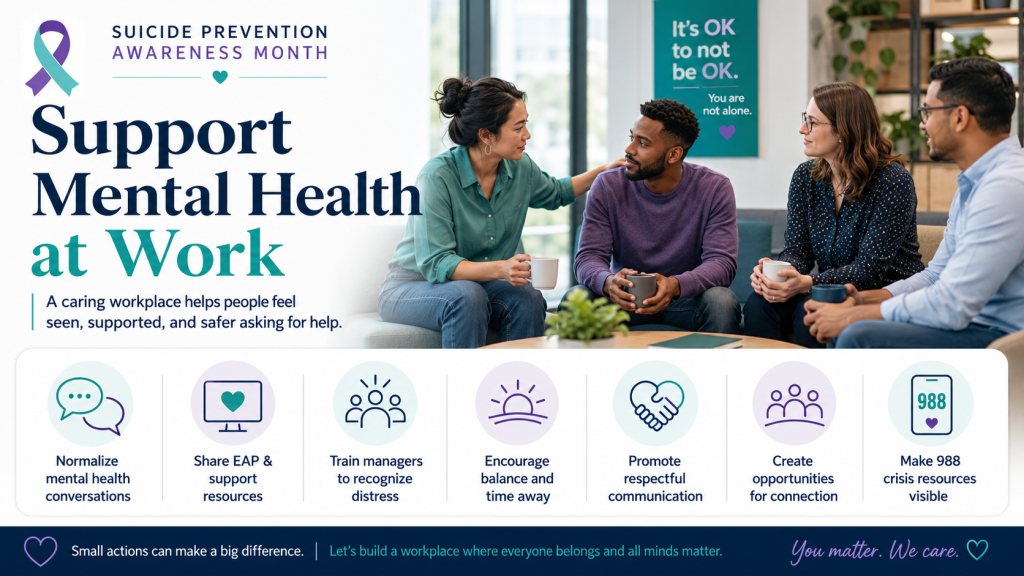
Employers can help by:
- Normalizing conversations about mental health
- Making Employee Assistance Program and behavioral health resources easy to find
- Training managers to recognize signs of distress
- Encouraging reasonable workloads and time away from work
- Promoting respectful communication
- Creating opportunities for connection
- Reminding employees that asking for help is a sign of self-awareness, not weakness
- Making crisis resources such as 988 visible and accessible
Federal workplace suicide-prevention guidance also emphasizes creating cultures that support employee well-being, help-seeking and connectedness.
A caring workplace cannot solve every problem an employee may be facing, but it can create an environment where people feel safer speaking up before they reach a crisis point.
Take Care of Your Own Mental Health
Suicide prevention also includes caring for our own emotional well-being.
Mental health deserves the same attention we give physical health.
Pay attention when stress begins to feel overwhelming. Give yourself permission to rest. Stay connected with people you trust. Move your body regularly. Spend time outdoors. Maintain healthy sleep habits when possible and recognize when you’re carrying more than you can manage alone.
And seek help early.
You do not have to wait until life becomes unbearable before talking with a counselor, therapist, doctor or someone you trust.
Sometimes asking for help is one of the strongest decisions a person can make.
You Don’t Have to Have All the Answers
One of the biggest misconceptions about suicide prevention is that you must know exactly what to say.
You don’t.
You don’t have to be a therapist.
You don’t have to solve someone’s problems.
You don’t have to give brilliant advice.
You can listen.
You can care.
You can ask.
You can stay.
And you can help connect someone with people who are trained to provide additional support.
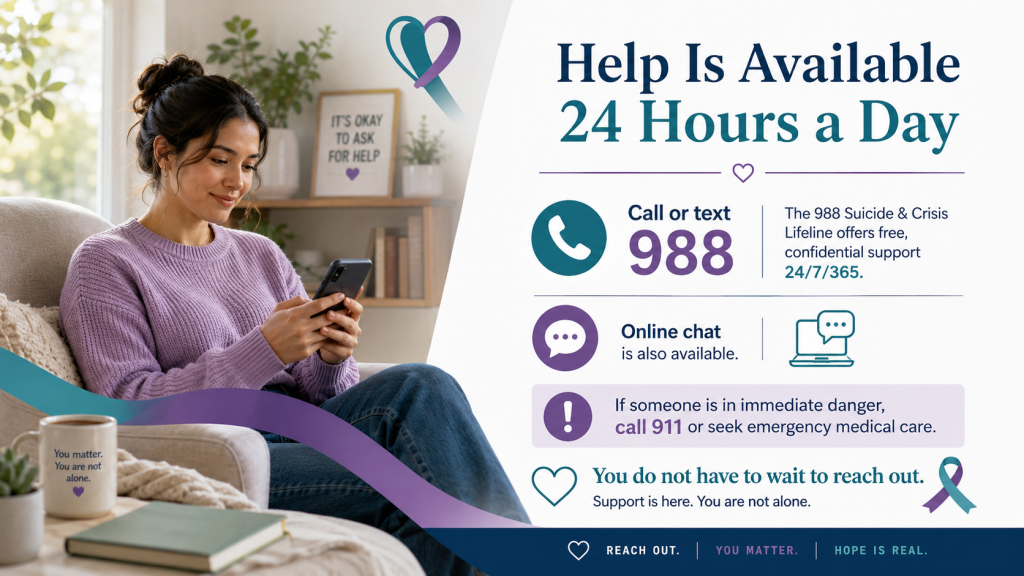
Help Is Available 24 Hours a Day
If you or someone you know is experiencing emotional distress, a mental health crisis or thoughts of suicide, the 988 Suicide & Crisis Lifeline is available throughout the United States.
Call or text 988.
The Lifeline provides free, confidential support 24 hours a day, 7 days a week, 365 days a year. People can also connect with a crisis counselor through online chat.
If someone is in an immediate life-threatening situation, call 911 or seek emergency medical care.
You do not have to wait until you’re certain something is a crisis to reach out.
Hope Starts With Connection
Suicide Prevention Awareness Month reminds us that conversations about mental health should not be limited to September.
People need connection all year long.
Notice the people around you.
Check in when something doesn’t seem right.
Listen without judgment.
Share resources.
Follow up.
And remember that sometimes one compassionate conversation can be the beginning of someone finding the help they need.
Connect. Support. Give hope.
Because everyone deserves to know that their life matters—and that they don’t have to face their hardest moments alone.
How to Bring Headache Awareness to the Workplace
Tuesday, May 11th, 2021
Promoting a happy and healthy work environment is essential to having a productive, prospering workplace. Migraines are a common deterrent to both productivity and attendance in employees. Outside of the general stress or tension headaches that plague many people, over 40 million Americans suffer from the neurological disease of Migraine headaches. Many migraine sufferers remain undiagnosed and untreated. Here are some ways to bring education and awareness to your workplace.
- Education and Treatment Options
According to recent studies, 52% of Migraine sufferers remain undiagnosed. Common over-the-counter treatment medications are insufficient to treat the multiple debilitating symptoms associated with Migraines. These symptoms may include nausea, vomiting, sensitivity to light and sound, and difficulty concentrating. All these things make it extremely difficult to work, leading to absences from work which we refer to as “absenteeism.”
Still, others are afraid of being labeled as unreliable and choose to stay at work amidst their symptoms. This leads to a decreased level of performance and a term we call “presenteeism.” Employees are present in the body at their job, but they are working at far less than optimal capacity. Presenteeism accounts for most of the cost to a company due to headaches.

The National Headache Foundation has created a program called “WorkMigraine” with education modules geared towards Employees, HR, and Employers respectively. These modules and resources are influential in educating individuals on headaches and treatment options. They have the potential to significantly decrease the loss of productivity due to headaches.
2. Omit or Minimize Triggers
Creating an environment that is sensitive to the needs of headache sufferers is a simple way to bring wellness to your workplace. If possible, omit or minimize the following triggers of headaches and migraines:
- Stress – promote a healthy lifestyle and relaxation techniques.
- Noise – minimize loud talking, music or machinery. Provide earplugs if needed.
- Light – flickering fluorescent lights can be problematic. A more indirect light source may be beneficial. Consider encouraging employees to use blue light glasses to help with computer screen glare.
- Odors – enforce a cologne-free workplace. Ensure there is proper airflow and fresh air. Designate a specific area for eating, away from workspaces.
- Posture – use ergonomic chairs and desks. Offer standing desks for those who may benefit from that option.

Some headaches may be avoided by limiting these common triggers. In addition, providing a dark, quiet space for employees who are struggling with headaches may prevent them from getting worse. This can allow an employee to recover quickly and be able to get back to work.
If all else fails, understand that an employee at work suffering from a migraine will not perform well. Encourage them to seek treatment and rest.
3. Have an Open Dialogue
Open communication with your employees is essential to good morale and finding solutions to any problems. When an employee can partner with their employer to come up with a plan, there can be progress. Have an open dialogue with employees about their specific headache triggers. Provide encouragement to seek treatment from a healthcare professional. Go over options for sick days and ways they can make up time they may miss due to their headaches.

Migraine sufferers are not unreliable. They have a neurological disease that needs attention and treatment. It is difficult to see the symptoms of a migraine outwardly, but with open communication, absenteeism and even presenteeism can be lessened and even avoided.
Visit The National Headache Foundation for more information and resources on Headache Awareness and the WorkMigraine program.
Health Benefits of Massage
Saturday, June 27th, 2020
Each July we observe Every Body Deserves a Massage Week to promote the health benefits of Massage in our communities. Often we think of massage as merely a luxury or spa type of experience. However, we will see that given its health benefits, it’s much more than that. More than just loosening tight muscles and being relaxing overall, massage can provide some real relief from a variety of health issues.
Health Benefits of Massage
Increase in Serotonin Levels
Massage has been found to increase serotonin levels in the brain, our brain’s “happy” chemical. More serotonin production has led to a decrease in chronic pain like fibromyalgia sufferers. It’s also shown to help decrease back pain, headaches, and even arthritis. Massage has been known to lower inflammation throughout the body, alleviating many conditions stemming from inflammation.

Rising levels of serotonin can also contribute to a better night’s sleep. Those who suffer from insomnia have found massage to be a great natural alternative to the many habit-forming medications currently prescribed as sleep aids. There are no long term side effects to massage as there are with narcotics making it a much safer choice.
A Decrease in Cortisol Hormone
Cortisol, our stress hormone, is responsible for much of our body’s ailments. Massage has a relaxing effect that decreases stress. This alleviates tension headaches, lower back pain, anxiety, and even depression.
A drop in cortisol levels can also help decrease blood glucose, making it extremely beneficial to diabetics. The increased blood flow provided by massage helps promote the effectiveness of insulin in the body, providing better blood glucose levels.

Increased circulation and decreased inflammation can also contribute to a better range of motion and flexibility. People with high blood pressure have also found frequent massage to be effective in lowering blood pressure.
Stimulation of The Lymphatic System
The lymphatic system carries fluid throughout the body. Health conditions that interrupt this flow contribute to swelling and lymph fluid build-up. Things like infections and cancer treatments can damage lymph nodes and create problems like lymphedema. Certain types of massage help to improve the lymphatic system, restoring the body’s natural processes.

As with any medical treatment, it’s best to consult with your physician about what methods might be best for you. Most of the health benefits listed here are found through regular massage treatments. Please visit our Wellness Observance Calendar for more information on Massage and to stay up to date on future health observances.
Secrets to Reducing Stress
Wednesday, April 6th, 2016
 As a sufferer of PTSD, I understand how important it is to get stress under control. I researched many ways of reducing stress and we all know about diet, exercise, meditation, and in some cases. Drugs. I agree that a healthy diet, regular exercise and time to quiet the mind is very necessary for reducing stress. However, this article is to give you a more in-depth view of how you can eliminate much of the anxiety you have in your life today.
Below have been the most effective means of controlling my stress, allowing me to have a happier and more productive lifestyle.
FEAR
Fear stresses the body more than any other emotion. The body reacts to fear for its ability to survive; NOT thrive. By living with a fearful mind, you can put the body into a “fight or flight” state. The body will begin to use adrenaline, causing your heart rate and breathing to increase. In this state the body cannot digest food properly, rest peacefully, or respond adequately to daily tasks. Sadly, many spend 100% of their time battling with their own fear. I call this “mindful fear”.
Mindful fears can only be released when you realize that it is not happening to you right now. Fear is simply our perception of a person or thing. Only the mind can produce fear. For example, when you feel a fearful thought, ask yourself if what you are thinking is really true, or is it simply a fear you are projecting? The body knows no difference between what is imagined and what is real. Once you realize that what you fear is NOT real, your body will relax knowing that it is again safe.
IMAGINATION
Playing pretend was part of every childhood, whether you were pretending to be an astronaut, cowboy, Wonder Woman or simply a mommy with her family, you were creating a happy reality by your thoughts. Imagine yourself and your life exactly how you would like it to be. Post photos of places and things in nearby places that remind you or represent that which you wish to achieve. Anytime you are feeling stressed, give yourself a few minutes to pretend that you have everything you want in life. Just by doing this you reverse the stress to a more positive, productive motion. It allows you to let go of the stress, putting your mind in a place that it is happy and relaxed.
Close your eyes for a moment or two and imagine the perfect outcome of any situation. By allowing your mind to visualize the most positive outcome, you are now allowing your mind to be open to other thoughts and ideas that are validated and created upon that thought.
GRATITUDE
We forget that there are so many things in life that we have to be grateful for. Anytime you are feeling stressed, you can turn your attention to the things in your life today (NOW) that you are grateful for. In an effort to always be getting somewhere or something, we often overlook all that we have successfully achieved along the way. By being grateful for that which we have, we allow more to come.
Dr. Robert A. Emmons of the University of California, has done much of the research on gratitude and has publicized “Gratitude is associated with higher levels of good cholesterol (HDL), lower levels of bad cholesterol (LDL), and lower systolic and diastolic blood pressure, both at rest and in the face of stress. It also has been linked with higher levels of heart rate variability, a marker of cardiac coherence, or a state of harmony in the nervous system and heart rate that is equated with less stress and mental clarity.”
Start a list of the things you are grateful for and add to that list daily.
THANK YOU!
Studies have proven that managers who say “thank you” to their employees find them to be more motivated and productive. Saying “thank you” works both for the giver and the receiver. Every time you say you thank someone, you reduce your own stress just by acknowledging a small act of gratefulness, not to mention, you will also have a better relationship with the person you thanked, and they too will have a better day.
The more love and appreciation we send to others, the more we feel it within ourselves. Practice smiling and seeing the world and all in it being in harmony with you. It will smile back at you.
Beat Stress at Work in 15 Minutes or Less
Monday, November 16th, 2015
We posted a couple weeks ago about the insidious nature of workplace stress and ways you can help combat it in your employees, but sometimes stress is fleeting and just an otherwise normal part of a busy day. Maybe you’ve just had two back to back meetings and are running late for a third or your computer spontaneously decided to stop working and you’re on a deadline. When these kinds of things happen, it’s important to try and get control over the resulting stress so it doesn’t negatively impact your entire day. 15 minutes and a little focus is all it really takes to make a major difference in your approach during or before a demanding, stressful day.
Share these easy tips with your employees and give them a shot yourself next time you’re stressed at work.
- Wake up early –
Although it’s not something you can do in 15 minutes, it is a simple tip that can have a huge impact on the flow of your day. It is also one that most people skip in favor of extra sleep. However, you’ll actually end up feeling much more well rested if you avoid waking up with just enough time to rush out the door without being late. Establish a morning routine that allows you to properly prepare for the day and allows you to feel relaxed and energized before a busy day.
- Clench and release your muscles –
Tighten a muscle group without straining for a period of 7 to 10 seconds and then relax. If a particular muscle group is already tense – start with that area. Otherwise, it’s easiest to start by tensing your shoulders up by your ears or clenching your fists and then releasing. If you’re stressed, you are probably placing a fair bit of tension throughout your body without even realizing it.
- Take deep breaths –
Now, this one is obvious but the main key here is to focus on making your exhales as long as possible. Start by Inhaling deeply and slowly for 2 to 3 beats and then try to exhale for the same length of time. Extend your counts as you continue to breathe deeply and you should find yourself significantly more relaxed in no time!
- Feel your pressure points –
Putting pressure on certain points of the body can help release tension by promoting blood circulation to that area. The next time you have a tension headache or are feeling frazzled, try placing your middle and index finger on your ‘Third Eye Point’ (the space between your eyebrows). Hold this position for one to two minutes while providing gentle pressure.
- Exercise –
Take a quick walk around your building or do some light stretching. Getting the blood flowing and redirecting your energy even for a brief period is often an easy way to clean your mental slate.
- Tidy your junk drawer –
Taking a few minutes to organize may be the last thing you feel like doing, but having a mindset of de-cluttering helps to manage stress. Focus on a small project or space – maybe straighten out that cluttered top desk drawer or rearrange some files. There is probably at least one thing you have been meaning to organize at your desk. Tangible organization helps with emotional organization.
- Write mental thank you notes –
As you start to feel yourself getting sucked into stress and the depressed/anxious thoughts that often follow, try to put a stop to it by shifting your thoughts to more positive ones. Start focusing on the things you are grateful for, look around you and try to appreciate anything you find beautiful or pleasant in that moment. If you can learn to shift your mental energy to find some kind of positivity, you often get a clear path out of stress. It can also be helpful to store a list of things you appreciate in your life in your phone to reference any time things start to get out of control.
How do you handle stress during the day? Have you used any of these tips yourself?