Migraine Awareness Month: Understanding the Invisible Disease That Affects Millions
Tuesday, June 9th, 2026
Every June, Migraine Awareness Month shines a much-needed spotlight on one of the most common, disabling, and misunderstood neurological diseases in the world. For too long, migraine has been dismissed as “just a headache,” minimized as a minor inconvenience, or misunderstood as something a person can simply push through. The truth is far more serious.
Migraine is a complex neurological condition that can affect the brain, body, emotions, senses, work life, family life, and overall quality of life. It can cause severe head pain, nausea, vomiting, dizziness, fatigue, sensitivity to light, sound, smell, and movement, vision changes, brain fog, numbness, speech difficulty, and lingering exhaustion long after the worst pain has passed. For many people, migraine is not an occasional headache. It is a chronic, disruptive condition that can impact relationships, careers, caregiving responsibilities, mental health, and daily independence.
Migraine Awareness Month is about more than wearing a ribbon or sharing a social media post. It is about education, compassion, advocacy, and action. It is a time to recognize the millions of people who live with migraine, validate their experience, reduce stigma, and encourage better access to diagnosis, treatment, workplace support, and community understanding.

Migraine Is Not “Just a Headache”
One of the greatest barriers people with migraines face is misunderstanding. Because migraine symptoms are often invisible, many people assume the person “looks fine” and therefore must be fine. But migraine is a neurological disease, not a simple headache.
A migraine attack can involve multiple phases. Some people experience warning signs hours or even days before the head pain begins. This early stage, called the prodrome phase, may include yawning, mood changes, food cravings, neck stiffness, fatigue, trouble concentrating, frequent urination, or sensitivity to light and sound.
Some people also experience aura. Aura can include visual changes such as flashing lights, zigzag lines, blind spots, or blurred vision. It may also involve tingling, numbness, dizziness, or difficulty speaking. Aura symptoms can be frightening, especially when they happen for the first time, and should always be discussed with a healthcare professional.
The headache phase of migraine may bring throbbing or pulsing pain, often on one side of the head, but migraine can also affect both sides or shift locations. Pain may worsen with movement. Many people also experience nausea, vomiting, sensitivity to light, sensitivity to sound, sensitivity to smells, dizziness, and extreme fatigue.
After the pain improves, the attack may still not be over. The postdrome phase, often called a “migraine hangover,” can leave a person feeling drained, foggy, weak, emotional, sore, or unable to return fully to normal activities for hours or even days.
Understanding these phases helps explain why migraine can be so disruptive. It is not only the hours of pain that matter. It is the entire cycle before, during, and after the attack.
Who Is Affected by Migraine?
Migraine can affect children, teenagers, adults, and older adults. It can affect people of every background, race, income level, and profession. However, migraine is especially common in women, often influenced by hormonal changes related to menstruation, pregnancy, postpartum changes, perimenopause, or menopause.
Migraine can also run in families. If a parent or close family member lives with migraine, others in the family may be more likely to experience it as well. But even without a family history, migraine can still occur.
For some people, attacks happen occasionally. For others, migraine becomes frequent or chronic. Chronic migraine is often defined as having headaches on 15 or more days per month, with migraine features on at least 8 of those days, for more than three months. Chronic migraine can be especially disabling and often requires a more comprehensive treatment plan.
Common Migraine Triggers
Migraine triggers are not the same for everyone. A trigger does not “cause” migraine by itself, but it may help set off an attack in someone whose brain is already vulnerable to migraine.
Common triggers may include:
Stress or the letdown after stress
Sleep changes or poor sleep
Skipped meals or dehydration
Hormonal changes
Bright lights or fluorescent lighting
Strong smells
Weather or barometric pressure changes
Alcohol, especially red wine
Certain foods or food additives
Too much caffeine or caffeine withdrawal
Screen glare
Loud noise
Overexertion
Neck tension
Changes in routine
It is important to remember that triggers can be complicated. Sometimes what appears to be a trigger may actually be an early symptom of the migraine itself. For example, a person may crave chocolate during the prodrome phase and later believe chocolate caused the attack, when the craving may have been part of the attack beginning.
Keeping a migraine diary can help identify patterns. Tracking sleep, meals, hydration, stress, weather changes, menstrual cycles, symptoms, medications, and attack timing can provide valuable information for both the patient and healthcare provider.
Treatment: There Is Hope
Migraine treatment has improved significantly. While there is no universal cure, many people can reduce the frequency, severity, and disruption of migraine attacks with the right plan.
Migraine care often includes three major categories: acute treatment, preventive treatment, and lifestyle or behavioral strategies.
Acute treatments are used when an attack begins. These may include over-the-counter pain relievers, prescription migraine-specific medications such as triptans, anti-nausea medications, gepants, ditans, or other medications recommended by a healthcare provider. The goal is to treat the attack early and effectively before symptoms become more severe.
Preventive treatments are used to reduce how often attacks happen or how severe they become. Preventive options may include daily oral medications, monthly injections, quarterly infusions, Botox for chronic migraine, CGRP-targeting therapies, gepants used preventively, neuromodulation devices, and other medical approaches based on a person’s symptoms, health history, and migraine frequency.
Lifestyle and behavioral strategies may also play an important role. Regular sleep, consistent meals, hydration, stress management, exercise as tolerated, relaxation techniques, cognitive behavioral therapy, biofeedback, and avoiding known triggers can help some people manage migraine more effectively. These strategies are not a replacement for medical care, but they can be a powerful part of a complete plan.
The most important message is this: people living with migraine deserve proper diagnosis and treatment. They should not be told to simply “deal with it,” “drink more water,” or “stop stressing.” Migraine is real, and help is available.
Migraine in the Workplace
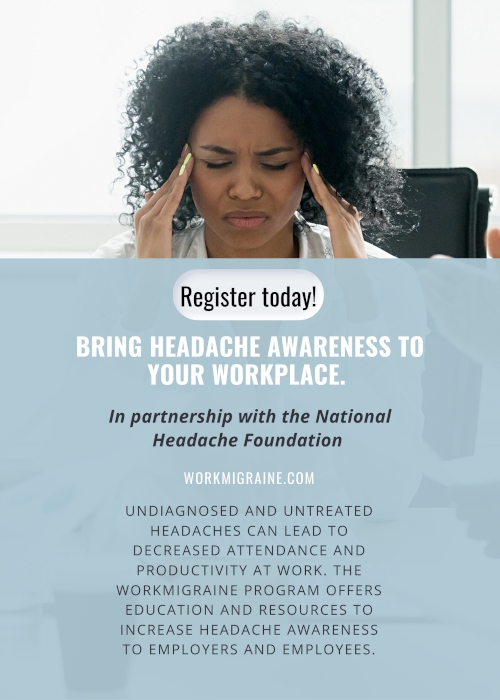
Migraine can have a major impact at work. Bright lights, computer screens, noise, strong odors, long hours, skipped meals, and high stress can all make symptoms worse. Because migraine is often invisible, employees may feel embarrassed or afraid to ask for support.
Workplace accommodations can make a meaningful difference. Helpful changes may include reducing harsh lighting, allowing screen filters or anti-glare monitors, offering flexible scheduling, allowing remote work when possible, providing access to a quiet dark space during an attack, reducing exposure to strong smells, allowing breaks for food and hydration, and supporting employees who need medical appointments.
Employers benefit when they take migraine seriously. Supportive workplaces can reduce presenteeism, absenteeism, stigma, and unnecessary suffering. A compassionate workplace culture allows employees to seek care, manage symptoms, and remain productive without feeling judged.
The Emotional Impact of Migraine
Migraine does not only affect the body. It can affect a person’s emotional well-being. People with frequent migraine may worry about when the next attack will happen. They may cancel plans, miss family events, fall behind at work, or feel guilty for needing rest. Over time, this can lead to isolation, frustration, anxiety, or depression.
The emotional burden is often made worse when others dismiss the condition. Statements like “Everyone gets headaches,” “You looked fine yesterday,” or “You just need to toughen up” can be deeply harmful. Migraine Awareness Month reminds us that compassion matters. Listening matters. Believing people matters.
Support from family, friends, coworkers, employers, and healthcare providers can make a real difference. Sometimes the most powerful thing you can say is, “I believe you. How can I help?”
When to Seek Medical Care
Anyone who experiences recurring headaches or migraine-like symptoms should talk with a healthcare professional. A proper diagnosis can help rule out other conditions and open the door to better treatment.
Emergency care is needed for a sudden, severe headache that feels like the worst headache of your life, a headache after a head injury, headache with fever or stiff neck, confusion, seizure, fainting, double vision, weakness, numbness, trouble speaking, or symptoms that feel very different from your usual migraine pattern. New aura-like symptoms should also be evaluated, especially if they have never been diagnosed before.
People should also seek medical advice if headaches are becoming more frequent, more severe, harder to treat, interfering with work or daily activities, or requiring frequent medication. Overuse of pain medication can sometimes make headaches worse over time, so a healthcare provider can help create a safer and more effective treatment plan.

How to Support Migraine Awareness Month
Migraine Awareness Month is an opportunity for everyone to help create change. You do not have to be a medical expert to make a difference.
You can learn the signs and symptoms of migraine.
You can stop calling migraine “just a headache.”
You can share accurate information.
You can encourage someone to seek care.
You can support migraine-friendly workplace policies.
You can listen without judgment.
You can advocate for better access to treatment.
You can participate in awareness events.
You can wear purple, the color commonly associated with migraine awareness.
You can share your story or amplify the stories of others.
Awareness leads to understanding. Understanding leads to compassion. Compassion leads to better care, better support, and better outcomes.
A Final Message for Migraine Awareness Month
Migraine is real. Migraine is disabling. Migraine is neurological. Migraine is often invisible, but the people living with it should never feel invisible.
This Migraine Awareness Month, let us move beyond outdated myths and make room for truth. Let us recognize the strength of those who live with migraine, the families who support them, the employers who accommodate them, and the healthcare professionals who help them find relief.
No one should have to suffer in silence. No one should have to prove their pain. No one should be dismissed because their disease cannot always be seen.
Migraine Awareness Month is a call to listen, learn, support, and advocate. Together, we can help build a world where migraine is understood, treatment is accessible, workplaces are compassionate, and every person living with migraine feels seen, heard, and supported.
What It Takes to Be the GOAT: The Impact of Mental Hygiene
Monday, February 2nd, 2026
Greatness is often explained through genetics, work ethic, or sacrifice.
That story is incomplete.
What separates the Greatest of All Time (GOAT) from the merely elite is not just physical mastery or technical skill—it is mental hygiene: the ongoing discipline of tending to one’s inner environment with the same rigor applied to physical training.
That has always been true.
What’s changed is this:
In the Age of AI, mental hygiene is no longer just for the GOATs.
It is becoming essential for anyone who wants to perform well or live a fulfilled life without being quietly overtaken by speed, noise, and feedback.
No modern athlete illustrates this more clearly than Simone Biles.

Simone Biles: Redefining Greatness Through Mental Hygiene
Biles has been dubbed the GOAT in gymnastics for her consistency, longevity, and, perhaps most importantly, for her ability to push the boundaries in her sport.
Simone Biles didn’t just dominate gymnastics, she redefined the psychological contract of excellence.
GOAT status achieved.
When she stepped away from competition at the Tokyo Olympics, many framed it as fragility. In reality, it was elite mental hygiene in action.
She recognized something fundamental:
- The body executes what the mind permits
- Precision sports punish even microscopic cognitive dissonance
- Ignoring internal signals is not toughness—it is negligence
Her decision was not avoidance.
It was maintenance.
Biles has spoken openly about:
- Regular therapy. Mental hygiene requires focused attention.
- Psychological safety as a prerequisite for peak performance. Genius requires vulnerability.
- Differentiating identity from output. Ever feel like a human-doing and not a human being?
- Treating mental clarity as non-negotiable infrastructure
That is not a weakness.
That is GOAT-level systems thinking.
Mental Hygiene: The Hidden Operating System of Greatness
Mental hygiene is not “positive thinking.”
It is not motivation.
It is not confidence.
It is the deliberate care of the meaning-making machinery that determines:
- Focus under pressure
- Decision-making at speed
- Recovery after failure
- The ability to sustain excellence without collapse
Every GOAT eventually learns the same lesson:
You do not rise to the level of your talent.
You fall to the level of your unexamined inner architecture.
Simone Biles simply learned it earlier—and publicly.
Other GOATs Who Built Mental Hygiene Regimes
Simone is not an anomaly. She is part of a quiet lineage.
Across eras and disciplines, the greatest performers didn’t just train their bodies—they trained their inner operating systems.
- Michael Jordan
Used visualization, emotional regulation, and ruthless narrative control. His edge was not rage—it was meaning discipline. - Serena Williams
Worked extensively with sports psychologists, breathwork, and emotional self-regulation to sustain dominance across decades. - Novak Djokovic
Treats meditation, breath control, dietary clarity, and cognitive reframing as performance fundamentals—not accessories. - Kobe Bryant
The “Mamba Mentality” was a structured internal practice: attention control, narrative precision, and emotional hygiene under pressure. - Tom Brady
Integrated mindfulness, body awareness, and identity separation to sustain elite performance into his mid-40s.
The pattern is unmistakable.
Why This Conversation Matters Now
These GOATs were performing at 100% in environments that demanded everything from them.
But here’s the shift:
You no longer need to be an elite athlete to experience elite-level cognitive pressure.
We are now living in a world where:
- Information never stops
- Comparison is algorithmic
- Feedback is instant
- Identity is continuously mirrored back to us
- Attention is fragmented by design
Some people reading this want to perform at the highest level of their field.
Others simply want to live a grounded, fulfilled life without feeling mentally hijacked.
In both cases, the challenge and opportunity is the same:
The modern mind is no longer stressed by effort alone —
it is stressed by the velocity of change.
The speed at which meaning, judgment, and possibility arrive now exceeds the nervous system’s natural capacity to integrate them without intentional hygiene.
It took roughly 10,000 years to go from writing to the printing press, but only 500 more to get to email. The number of happenings in our time compared to those of our ancestors is unprecedented.
What used to take 10,000 years, now takes 1,000.
Novelty that used to manifest inside 100 years now appears in 10.
Futurists and technologists have used metaphors and heuristic models, like Buckminster Fuller’s ‘knowledge doubling curve’, to describe how human knowledge and digital information are accelerating at unprecedented rates. The Age of AI changes the very way these models measure our experience.
This is why mental hygiene is no longer optional.
It is becoming infrastructure.
Mental Hygiene in the Age of AI

Artificial intelligence is not just changing how we work.
It is changing how meaning forms. We are living in a society that programs us through 90-second AI-augmented video clips. A world where we need a natural discernment in everything we see. Our cognitive load is shifting. We have to learn now to orient and navigate in a busy, noisy world.
The illiteracy of our age isn’t about being able to read or write. It’s about whether we can begin to orient in a world our old programming wasn’t designed to operate from. Can we learn, unlearn, and then relearn again?
When:
- Narratives update instantly. The Velocity of change is passing a tipping point.
- Feedback loops never close. News is global and 24/7, all focused on suffering. Suffering sells
- Identity becomes data-reflected
- Thought accelerates without pause
Unexamined inner patterns don’t disappear.
They accelerate.
Old assumptions become faster loops.
Unresolved meaning gets louder.
Automatic reactions begin to feel like “who we are.”
People don’t burn out because they’re weak.
They burn out because they are running outdated inner software at modern speeds.
The GOATs sensed this intuitively.
Most people are only now beginning to feel it.
From Performance Hygiene to Personal Hygiene
Elite performers treat mental hygiene the way pilots treat instruments:
- Not as inspiration
- Not as self-help
- But as navigation
For some, this is about winning medals.
For others, it’s about:
- Not losing themselves
- Not living in chronic reactivity
- Not confusing pressure with purpose
- Reclaiming agency and purpose to the “I am”.
The principle is universal:
If you don’t tend the inner environment,
the environment will tend you.
Introducing Turning Within
This is where Turning Within fits—not as a philosophy, but as practice. (Learn More Here)
Turning Within is a personal mental hygiene discipline designed to help practitioners:
- Recalibrate their inner orientation
- Examine and update deep conscious patterns
- Interrupt and recalibrate automatic feedback loops in a high-speed world
- Integrate a deeper, more conscious, purposeful version of self in all facets of life.
In a modern mind moving at light speed, meaning doesn’t just form—it feeds back on itself:
- Meaning drives narrative.
- Narrative flows in story form.
- Story forms and is informed by belief.
- Perception reinforces the original thought.
Turning Within gives people a way to:
- Slow that loop down
- See it clearly
- Change it deliberately
Not to escape reality.
But to engage it with agency.
Just as physical hygiene prevents illness,
mental hygiene prevents distortion.
And distortion scales fast now.
The Pattern Is the Point
Across disciplines, eras, and personalities, the pattern is consistent:
- Physical training builds capacity
- Technical training builds execution
- Mental hygiene sustains and creates conscious coherence
GOATs don’t just train harder.
They maintain their inner environment so pressure doesn’t distort perception, identity, or choice.
Simone Biles didn’t step back from greatness.
She demonstrated it.
The Real Question
The real question is no longer:
“Do you have what it takes to be the GOAT?”
It is:
“Are you willing to maintain your mind with the same seriousness you maintain your life?”
Because talent without mental hygiene doesn’t fail loudly.
It fails slowly—through burnout, distortion, and loss of agency.
In the Age of AI, that slow failure happens faster. Equally, what used to be available for the few is now the experience of many. Greatness, real greatness… and a fulfilled life now share the same requirement:
Mental hygiene.

Promoting a Safe & Healthy Workplace
Friday, February 21st, 2020
“Almost 3 million workers die each year from occupational accidents and work related diseases. This is an unacceptable and avoidable human cost. We can and must reduce and eliminate such deaths, injuries and diseases from work.”
International Labour Organization Director-General, Guy Ryder

The quote above is extremely sobering. When we realize that the vast majority of these illnesses and deaths are due to mere human error, we understand how important greater education and prevention truly are. We cannot afford so many lives lost or affected by our carelessness or neglect.
At IAB, we are doing our part to spread health education in the workplace. We connect healthcare providers with employer groups to help bring wellness to the workplace. This April 28th, we observe World Day for Safety and Health in the Workplace. Each year the International Labour Organization focuses on a specific theme for this day. Below we will go over some practical ways to promote health and safety in your workplace.
Healthy Habits in the Workplace

- Handwashing
- Handwashing is always the single most effective and simplest way to prevent the spread of disease. You should always wash hands after using the restroom. Wash hands at the start of your shift, after removing any protective gloves, between patients, before food prep, etc. Be mindful of the type of work you’re in and fill in appropriate times when diseases could potentially be spread. Never underestimate the importance and effectiveness of handwashing. Keeping a generally clean and sanitary work environment also prevents the spread of disease.
- Ventilation
- Proper air ventilation can also help prevent the spread of disease. The building humidity should be kept at 60 percent or less to inhibit the growth of any mold or fungus. Ensure that the building’s ventilation system is maintained properly. Circulation of fresh air keeps bacteria from growing and provides healthy air to breathe.
- Vaccinations
- Keep up to date on all the recommended vaccinations. Providing on-site vaccinations that pertain to your line of work is an extra measure that is well worth the effort. Tetanus and Flu shots are beneficial to everyone. Certain hepatitis vaccinations should be emphasized to protect those working with children, in healthcare or waste collection. Consult your doctor for the best vaccine recommendations for your workplace.
- Protective gear
- If you can potentially come into contact with any type of hazardous material at work, the proper protective covering can be life-saving. Eyes and mouths are vulnerable areas that can easily contract an illness. Keep them covered with masks, face shields, respirators, and safety glasses. Use gowns and gloves to cover clothing and hands which can carry infectious material. Without these coverings, diseases can be spread from person to person or from hand to face.
Safety in the Workplace

Safety policies and procedures are extremely important. But they are only useful if they are actually practiced. Review policies frequently and make sure all employees are familiar with them. Making safety a priority has to become a habit and habits take time to develop. When you create a work environment that promotes safe practices, it has to start with the employer to trickle down to the employees. Create a culture of safety and new employees will naturally be grafted in.
Other things to keep in mind when promoting a safe work environment:
- Always wear protective safety gear where appropriate.
- Understand that safety is non-negotiable.
- Take extra care to hire employees with integrity who will put safety first and not cut corners.
- Make plans and practice procedures for emergency situations.
- Provide proper training and multiple opportunities for practice.
ILO 2020 Theme: Violence and Harassment in the World of Work

Violence and harassment are unfortunate realities in the workplace. Where there are large groups of people, there will always be a risk for some occurrence of inappropriate or dangerous behavior. Here are some practical ways we can help decrease their occurrence or at least head them off before any real danger occurs.
- Employers –
- Be sure to check on the morale of your employees. You can’t monitor everyone all the time, but if you’re an easy person to approach, employees are more likely to come to you when there is a problem.
- Hire people for their skill level but also for their character.
- Offer training and materials on what to do if you experience or witness bullying or harassment at work.
- Have a harassment policy and review it often.
- Employees –
- Speak up. If you feel as though you or a coworker may be in danger, tell someone about it. Don’t try to handle it on your own. Making a big deal out of nothing is better than waiting until it’s too late.A Forbes article on Workplace safety gave this real-life example:
A woman overheard a colleague talking fearfully to her boyfriend while on a break outside the building; the woman was pleading with her boyfriend not to show up at her office. The colleague reported this to Human Resources and they called the police who showed up mere minutes before the boyfriend appeared; he was armed. By speaking up, the colleague had saved the day.
- Know your rights. If you’re being harassed or discriminated against report it.
- Keep notes on occurrences of harassment with as many details as possible.
- Call the police. If you’ve become a victim of a criminal act, do not hesitate to contact authorities.
- Speak up. If you feel as though you or a coworker may be in danger, tell someone about it. Don’t try to handle it on your own. Making a big deal out of nothing is better than waiting until it’s too late.A Forbes article on Workplace safety gave this real-life example:
Together we can make our workplace a safer and healthier place to be. Training and prevention are absolutely essential for our success in diminishing the number of casualties each year. Visit our National Wellness Observance Calendar for more resources on World Day for Safety and Health at Work.
5 Things You Never Knew About Your Liver
Tuesday, October 22nd, 2019
If I asked you what the most important organ in your body is, what would you answer? You’d probably say, your heart or maybe your brain. Some might even think of their lungs. All these organs are indeed essential to life. But there’s another incredibly important organ, essential to life, that often goes unnoticed: the liver. The liver is the largest solid organ in your body and is responsible for more than 500 functions. More than 500 because its functions are still being explored! We still don’t know the extent of its importance. Our bodies are incredible! Let’s explore 5 things you never knew about your liver and how we can keep it functioning in tip-top shape.
1. The Liver is Like a Starfish

Your liver is the only organ that can regenerate. Liver disease in extremely common and can lead to liver cancer. Liver cancer only occurs in people with a preexisting condition, such as obesity, hepatitis or alcohol abuse. In some cases, individuals have had the diseased portion of their liver removed. Many have gone on to live healthy lives with only part of their liver in tact. This is because it’s able to regenerate to its full size in a matter of mere months.
2. It Gives You Energy

Your liver breaks down carbohydrates and turns them into glucose: your body’s energy source. It stores glucose in the form of glycogen and is able to tap into it whenever you need a burst of energy! This why low blood sugar means low energy. Be sure to give your liver some complex carbs and whole grains to use as fuel so you don’t crash and burn.
3. It Keeps You From Getting Sick
Within the liver are a large number of cells necessary for your body’s immunity. These are called Kuppfer Cells or “KC”. Kuppfer cells are disease-fighting agents that fight off any bad gut bacteria that could make you sick. So when your body is fighting off an infection, thank your liver!
4. Helps You Lose Weight

This one is multi-faceted. Firstly, the liver produces bile. Bile is used to break down fat, cholesterol and vitamins so that they can be used by your body. Without your liver, carbohydrates, fats and proteins wouldn’t be able to be metabolized properly. Because of your liver, your body can use fat and carbs for energy rather than just storing them as extra weight. It’s also able to remove excess hormones from the body like estrogen and aldosterone. Too much of these hormones can lead to weight gain. Detoxing your liver may aid your weight loss efforts by enabling your liver to do its job more efficiently.
5. Poison Control
Perhaps the one thing you already knew about your liver is that it’s your body’s filtration system. It filters impurities and toxins from your blood and aids your digestive system. This is why consuming large amounts of alcohol and medications can be so damaging to your liver. Think of your air filter in your home or your car. What happens to it after a period of time? It starts looking really dirty and gross. It can’t function as well after all that filtering of poisons in your body.

Cleaning the Filter
So how do we reboot our liver and keep it functioning well? Even if you don’t use alcohol, the regular breakdown of proteins can create toxins in your bloodstream. Your liver is always filtering out the bad stuff. Taking a supplement with milk thistle and dandelion root is an excellent way to detox your hardworking liver. Turmeric, garlic, green veggies and even drinking tea have also been shown to have detoxing benefits. Basically eating a healthy diet and lifestyle is the best way to care for your liver.
October is Liver Cancer Awareness Month. Visit our Wellness Observance Calendar for more information on keeping your liver healthy.
How to Age Gracefully
Friday, September 6th, 2019

Age is just a number, they tell us. But it seems we’re getting older, younger and younger. Some twenty-somethings feel as though they’re pushing sixty. How do we keep our minds and bodies in tip-top shape as we age? Are the aches, pains and ailments just inevitable? Let’s discuss how to age gracefully. Hopefully, you’ll find a new lease on life in the paragraphs that follow.
Eat A Balanced Diet
This first tip is a simple one. It’s used so frequently, it may seem trite. But the simplicity and importance of eating a balanced diet cannot be overestimated. With all the fad diets and extreme restrictions out there, balance can be hard to come by. The fads will come and go. There is no one food group that can be termed “bad.” Most everything has a benefit in moderation.

Don’t deprive yourself of good foods that you like to eat. Just eat more fruits, veggies, lean meats and whole grains. Even carbohydrates are important. It can be tempting for weight loss to eliminate carbs almost entirely. Just like carbs are important, many healthy fats are rich in Omega vitamins essential for good heart and brain health.
Some people do have to monitor carbs more closely for other health concerns. But an extreme diet can deprive your body of nutrients it actually needs. While you may experience weight loss in the short term, what’s most important? Losing weight quickly, right now? Or sustaining a healthy, balanced diet over time that will lead to a healthy weight in addition to a long healthy life.
Move Your Body
Never stop moving your body. A body at rest remains at rest. Muscles that aren’t used deteriorate over time. That can lead to your body ceasing to function and move the way it used to. Simple walking and daily stretching can do wonders for your cardiovascular and muscle health. Getting your heart rate up and releasing those feel-good endorphins fights a world of health issues.

Studies have shown that older adults who maintain active, healthy lifestyles, are 60% less likely to develop dementia. The way you treat your body affects your mind, just as the way you treat your mind affects your body. The mind-body connection is a powerful thing.
Think Youthful Thoughts
Our mental health contributes much more to our overall health than you might think. There are many who are dead long before their bodies are buried. Don’t be one of them! Live your life to the fullest. Make plans, set new goals, dream new dreams. As long as you have breath you have a purpose to fulfill. Meditation or Prayer has even shown to improve age-related memory loss. Meditation can contribute to your physical and emotional health by decreasing stress and improving mental clarity.

Invest in our youth! Mentor someone younger than you. Volunteer with after school programs or be a big brother/sister. Being around young people keeps you dialed in and aware. We tend to be most like the people we spend time around. Keeping our associations varied opens our minds to learning new things. Learning new things keeps our minds healthy.
Sharpen and challenge your mind to think. When you cease to learn, you cease to truly live. Take up a new hobby or audit a college course. An endless supply of knowledge can be found simply by taking up the habit of reading. When you continue to utilize your thinker, you guard yourself against dementia and strengthen your mind.
Wear Your Sunscreen
Your skin is your largest organ. Don’t neglect to take care of it! It’s the first thing people see and one of the biggest indicators of your age. Sun damage to your skin is a huge cause of aging. Not only does it age your skin, but you also run the risk of developing skin cancer. Skin cancer takes many lives every single year.
Never underestimate the impact of a good skincare routine, both for men and women. Begin your preventative care as young as age 25. The damage done to our skin only shows up about ten years after it occurs. Be diligent in your skincare routine and you will see a marked difference in your youthful appearance.

For women, it’s important to use a cleanser, toner, eye cream, treatment product (anti-wrinkle or brightener) moisturizer, and exfoliate regularly. Men tend to exfoliate and moisturize the lower portion of their face through shaving. They show their age on their forehead and around their eyes. Daily sunscreen in addition to an equally good skincare routine is just as important for men.
Own it!
Don’t fight the aging process, embrace it. You’ve earned your age and you have the wisdom and life experience to prove it. Every new day is a gift. You’ve been given this life and this body and it’s up to you what you do with them. Take care of yourself, whether you’re 22 or 92. None of us lives forever, but let’s live well.