Suicide Prevention Awareness Month: Connection, Hope and Support Can Save Lives
Monday, August 31st, 2026
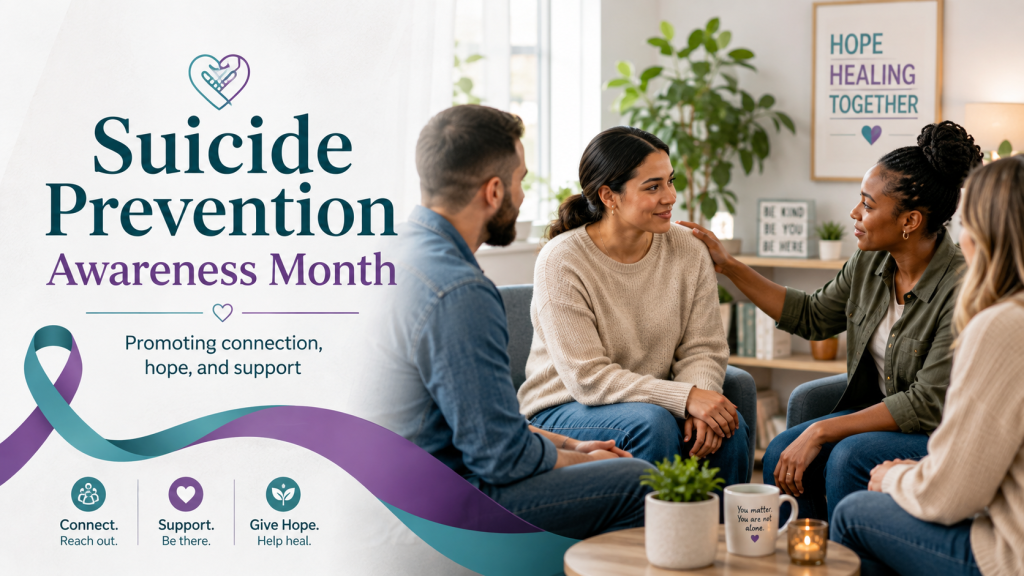
Every September, Suicide Prevention Awareness Month provides an opportunity to bring an often difficult subject into the light.
It is a time to remember those whose lives have been lost to suicide, support people who have struggled with suicidal thoughts, acknowledge the families and communities affected, and remind one another that help, treatment and hope are available.
Suicide prevention is not only the responsibility of mental health professionals. Friends, family members, coworkers, managers and communities can all play a role by creating stronger connections, recognizing when someone may be struggling and helping people reach appropriate support.
Sometimes the most meaningful first step is simply letting another person know:
I see you. I care about you. You don’t have to face this alone.
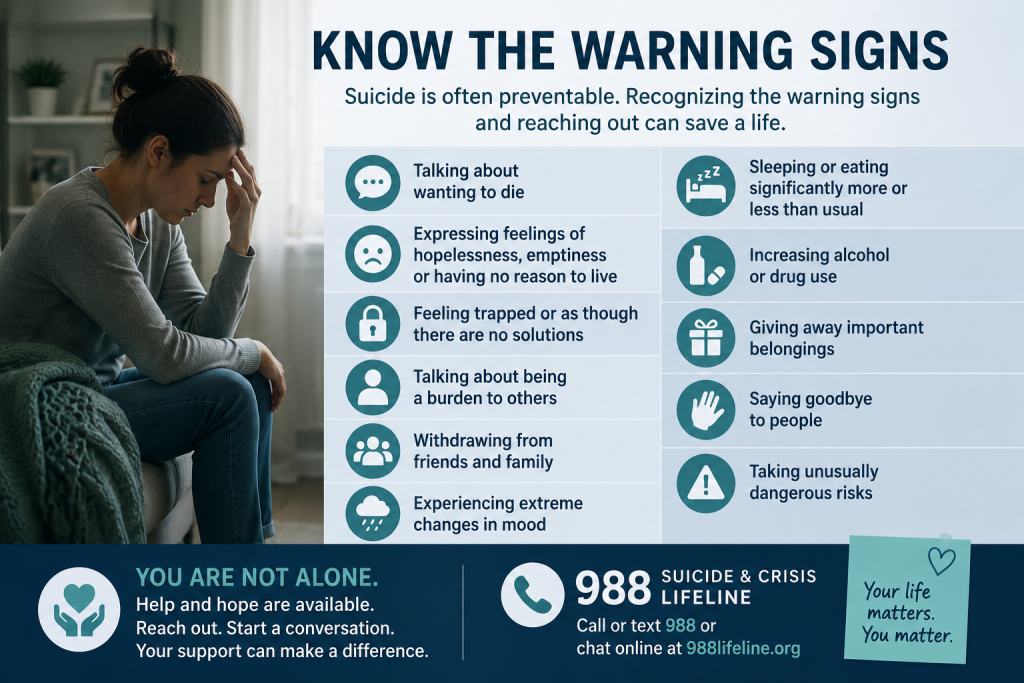
Know the Warning Signs
Emotional distress does not always look the same from one person to another. Someone may appear sad and withdrawn, while another person may seem angry, anxious or unusually restless.
The National Institute of Mental Health identifies a number of warning signs that can indicate someone may be experiencing suicidal thoughts. These can include:
- Talking about wanting to die
- Expressing feelings of hopelessness, emptiness or having no reason to live
- Feeling trapped or as though there are no solutions
- Talking about being a burden to others
- Withdrawing from friends and family
- Experiencing extreme changes in mood
- Sleeping or eating significantly more or less than usual
- Increasing alcohol or drug use
- Giving away important belongings
- Saying goodbye to people
- Taking unusually dangerous risks
A particularly important concern is a new or significant change in someone’s behavior, especially when it follows a painful loss, major life event or other difficult experience.
Knowing the warning signs doesn’t mean we should try to diagnose someone. It means we can recognize when it may be time to reach out.
Don’t Be Afraid to Ask
Many people worry that asking someone whether they are thinking about suicide might somehow put the idea into that person’s mind.
Research does not support that fear. According to the National Institute of Mental Health, asking directly about suicidal thoughts does not cause or increase them. A direct, caring question can instead help identify someone who needs support.
If you’re concerned about someone, don’t feel as though you need to find the perfect words.
Start a conversation.
Tell the person you’ve noticed that they don’t seem like themselves and that you’re concerned about them. Listen without judgment and allow them to talk.
If necessary, ask directly whether they are thinking about suicide.
The important thing is to approach the conversation with compassion rather than fear, criticism or embarrassment.
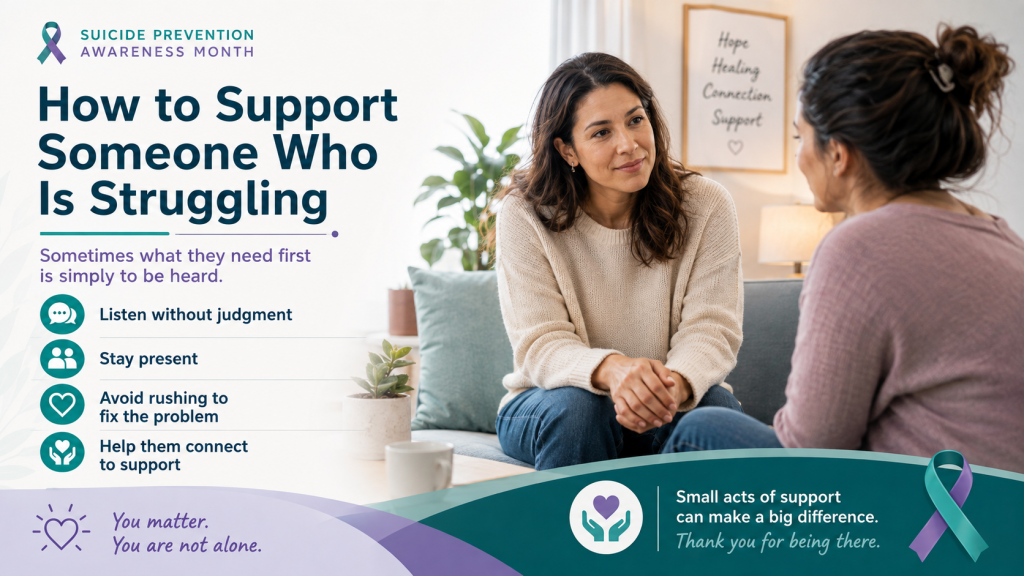
How to Support Someone Who Is Struggling
When someone shares that they are struggling, our natural instinct may be to immediately try to fix the problem.
Sometimes what they need first is simply to be heard.
Give the person your full attention. Listen without minimizing what they’re feeling or immediately comparing their situation to someone else’s.
Avoid responses such as, “You have so much to be grateful for,” or “Other people have it worse.”
Instead, acknowledge that they are hurting.
Stay present. Ask what they need. Encourage them to connect with a mental health professional, physician, Employee Assistance Program, crisis counselor or another trusted source of support.
If someone tells you they intend to end their life, do not leave them alone and do not promise to keep it secret. Seek immediate help.
And don’t underestimate the importance of following up later.
A text message, phone call or simple question such as “How are you doing today?” can remind someone that they haven’t been forgotten.
Connection Matters
Human beings need connection.
Feeling supported by family, friends, coworkers and community can help protect emotional well-being. The CDC identifies social connectedness as an important protective factor and encourages communities to create opportunities that reduce isolation and strengthen relationships.
That doesn’t always require a formal program.
Invite someone to lunch.
Call the friend you haven’t heard from lately.
Check on a coworker who’s been unusually quiet.
Invite a neighbor for a walk.
Include someone who seems to be on the outside of a group.
Small moments of genuine human connection can matter more than we realize.
Support Mental Health at Work
Because adults spend so much of their lives working, the workplace can play an important role in supporting mental health.
Work-related stress can affect an employee’s well-being both on and off the job, and managers and supervisors can help create healthier environments by addressing unnecessary workplace stress and making support easier to access.
Employers can help by:
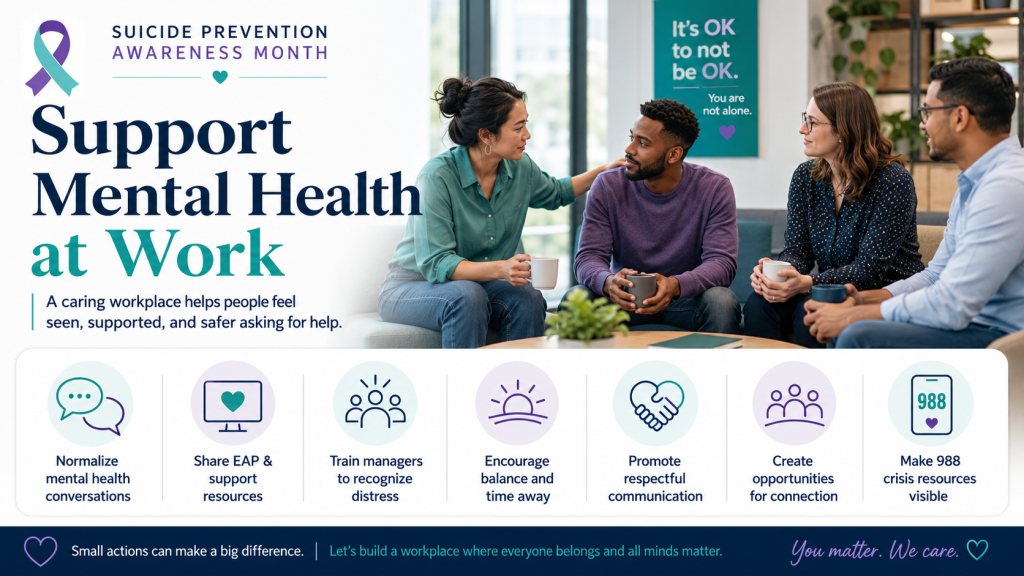
- Normalizing conversations about mental health
- Making Employee Assistance Program and behavioral health resources easy to find
- Training managers to recognize signs of distress
- Encouraging reasonable workloads and time away from work
- Promoting respectful communication
- Creating opportunities for connection
- Reminding employees that asking for help is a sign of self-awareness, not weakness
- Making crisis resources such as 988 visible and accessible
Federal workplace suicide-prevention guidance also emphasizes creating cultures that support employee well-being, help-seeking and connectedness.
A caring workplace cannot solve every problem an employee may be facing, but it can create an environment where people feel safer speaking up before they reach a crisis point.
Take Care of Your Own Mental Health
Suicide prevention also includes caring for our own emotional well-being.
Mental health deserves the same attention we give physical health.
Pay attention when stress begins to feel overwhelming. Give yourself permission to rest. Stay connected with people you trust. Move your body regularly. Spend time outdoors. Maintain healthy sleep habits when possible and recognize when you’re carrying more than you can manage alone.
And seek help early.
You do not have to wait until life becomes unbearable before talking with a counselor, therapist, doctor or someone you trust.
Sometimes asking for help is one of the strongest decisions a person can make.
You Don’t Have to Have All the Answers
One of the biggest misconceptions about suicide prevention is that you must know exactly what to say.
You don’t.
You don’t have to be a therapist.
You don’t have to solve someone’s problems.
You don’t have to give brilliant advice.
You can listen.
You can care.
You can ask.
You can stay.
And you can help connect someone with people who are trained to provide additional support.
Help Is Available 24 Hours a Day
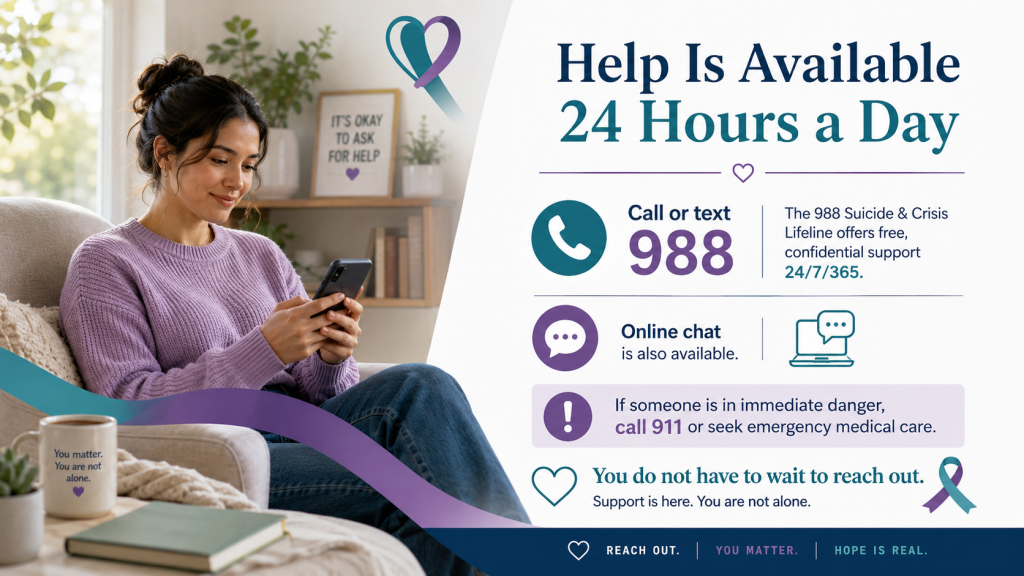
If you or someone you know is experiencing emotional distress, a mental health crisis or thoughts of suicide, the 988 Suicide & Crisis Lifeline is available throughout the United States.
Call or text 988.
The Lifeline provides free, confidential support 24 hours a day, 7 days a week, 365 days a year. People can also connect with a crisis counselor through online chat.
If someone is in an immediate life-threatening situation, call 911 or seek emergency medical care.
You do not have to wait until you’re certain something is a crisis to reach out.
Hope Starts With Connection
Suicide Prevention Awareness Month reminds us that conversations about mental health should not be limited to September.
People need connection all year long.
Notice the people around you.
Check in when something doesn’t seem right.
Listen without judgment.
Share resources.
Follow up.
And remember that sometimes one compassionate conversation can be the beginning of someone finding the help they need.
Connect. Support. Give hope.
Because everyone deserves to know that their life matters—and that they don’t have to face their hardest moments alone.
Mental Health & Suicide Prevention
Tuesday, September 10th, 2019

The assault on our mental health is a daily battle we each face. Some of us fare worse than others. It’s important to understand how to cultivate good mental health. When we keep our minds healthy, we help prevent suicide. We must also be aware of the struggle in others. Mental struggles are all but invisible. It takes intentional effort to know each other well enough to sense when something isn’t right. We must express care and concern about the internal struggles of our loved ones. As a community, we must encourage and lift each other up.
Good Mental Health Habits
- Get Enough Sleep
- When we don’t get enough rest, our minds can become unhinged. Irritability, moodiness and depression set in. Read more about the correlation between sleep and mental health in an article from the Harvard Medical School website.
- Eat a healthy diet.
- Nutrition has a major effect on our energy levels and overall mental wellness. Certain foods can make us feel sluggish and glum. Other foods can actually brighten our mood and give us energy.
- Exercise
- Exercise has to be one of the single most effective tools for our mental health. Getting your heart rate up releases those feel-good endorphins that keep us upbeat and positive. Start your day with a good sweat session and you’ll feel ready to take on the world.
- Socialize
- Yes, even for introverts, socialization is important. When we keep to ourselves, we’re alone with our thoughts and create even more isolation. It’s easy to feel alone, even in a crowded room. But when we engage in real conversation with others, it broadens our perspective. When we share in each other’s struggles and victories, we are operating in a community with one another. It is in sharing our lives with each other that we begin to understand how we are all truly more alike than we are different.

- Don’t Be a “Yes Man”
- Know what healthy boundaries you need to keep in place for your mental health. Try not to wait until you’re at the end of your rope to take a break. It’s important to rest, to be alone with your thoughts and process. Some people keep so busy that they never really know how they’re feeling until they’re too far down the wrong path. You can do anything, but you can’t do everything. Knowing when to say no is an important thing to learn.
- Put Your Phone Down
- Our phones never leave our side. Hours can go by with you just scrolling through other people’s lives. There’s a constant barrage of information coming at your brain and the stimulation can be mentally exhausting. We are more connected by social media than ever before, yet most of us are realizing just how shallow and isolating that connection tends to be. Make sure you put your phone down once in a while and talk to a human face to face. Turn your phone off and put it in a drawer for an hour or two and feel the freedom of not checking it every few seconds.
- Get Outside
- There’s something very grounding and clarifying about being in the outdoors. Going for a quiet walk around the neighborhood or watching the sunset can do wonders for your mental well being. Don’t underestimate the simplicity of getting more oxygen to your body by being outside. Observing how nature is functioning around you is a great reminder that the world is bigger than you and that everything will be all right.

Signs of Poor Mental Health
- Isolation
- Staying in a never going out. Insisting that you have too much to do when really you just can’t bear to be around others. You may even hold the belief that you’re the only one who knows what you feel like. No one else has felt the way you do. No one will ever understand.
- Depression
- When depression sinks in, every day it’s a struggle just to function. Getting out of bed is a huge accomplishment. Sadness or general indifference permeates every single day.
- Comparison
- Constant comparison with others can make us feel lacking in every area. Even though we know that what we see on TV, movies, or even on social media is curated to look a certain way. We are never seeing the full story. Yet mentally we may begin to feel as though we can never measure up. When we start to compare we become focused on what we lack, instead of what we have. We find our relationships, homes, clothing, finances, all come up short when compared to what we see.
- Hopelessness
- Feeling as though things will never get better, that we’ve screwed up too much or missed our chance perpetuates feelings of hopelessness. The truth is that there is always hope. But when you are caught in a cycle of hopelessness, that can be difficult to believe.
Poor mental health can easily lead to a thought process that may end in suicide. If you have thought about ending your life or believe the world would be better without you, please reach out to someone. Let them prove you wrong. Come up with a safe action plan to protect you from those dark thoughts. You are important and valuable and we need you here.
How Can We Help?
If you or someone you know is showing signs of poor mental health, here are some steps to take. Being equipped with the right expectations and resources for our mental health and the mental health of others is a starting point for winning the fight against Suicide.

- Be Bold. Ask Pointed Questions.
- Don’t be afraid to be awkward or embarrass yourself by asking someone if they’re planning to commit suicide. Their life may depend on your boldness. Isn’t that worth more than what someone may think of you? Ask exploratory questions: Have they made a plan to do it? Do they have access to the resources they need? Let them know you are coming to help them or encourage them to go to someone they feel safe with.
- Talk About It.
- Share your stories. Not everyone has the signature signs and symptoms. Sharing the stories of loved ones you’ve lost to suicide or how you overcame an attempt on your own life can potentially save the life of someone else.
- Be present and aware.
- Don’t let people slip through the cracks. Learn people’s names and let them know they’re valued by you. You never know what a smile or kind word may do in the life of someone else. It could mean the world to someone starved for love and attention.
- Be others-focused.
- We all have our own issues we are working through. When we focus on our problems, they tend to grow. When we look outside ourselves to the needs of others, we not only help them. We help ourselves in the process. If each of us focused on the well being of the person next to us, we’d all be taken care of. It has to start somewhere. Why not with you?
- Forgive Yourself.
- If it’s too late for someone you love, know that you’re not at fault. You can do everything “right” and still lose someone. Give their life more meaning by sharing their stories and helping someone else. Be kind to yourself and honor their memory.
For further information or assistance visit our wellness observance page or call 1-800-273-8255 to talk to someone any time of day. An online chat is also available to you right now.