Migraine Awareness Month: Understanding the Invisible Disease That Affects Millions
Tuesday, June 9th, 2026
Every June, Migraine Awareness Month shines a much-needed spotlight on one of the most common, disabling, and misunderstood neurological diseases in the world. For too long, migraine has been dismissed as “just a headache,” minimized as a minor inconvenience, or misunderstood as something a person can simply push through. The truth is far more serious.
Migraine is a complex neurological condition that can affect the brain, body, emotions, senses, work life, family life, and overall quality of life. It can cause severe head pain, nausea, vomiting, dizziness, fatigue, sensitivity to light, sound, smell, and movement, vision changes, brain fog, numbness, speech difficulty, and lingering exhaustion long after the worst pain has passed. For many people, migraine is not an occasional headache. It is a chronic, disruptive condition that can impact relationships, careers, caregiving responsibilities, mental health, and daily independence.
Migraine Awareness Month is about more than wearing a ribbon or sharing a social media post. It is about education, compassion, advocacy, and action. It is a time to recognize the millions of people who live with migraine, validate their experience, reduce stigma, and encourage better access to diagnosis, treatment, workplace support, and community understanding.

Migraine Is Not “Just a Headache”
One of the greatest barriers people with migraines face is misunderstanding. Because migraine symptoms are often invisible, many people assume the person “looks fine” and therefore must be fine. But migraine is a neurological disease, not a simple headache.
A migraine attack can involve multiple phases. Some people experience warning signs hours or even days before the head pain begins. This early stage, called the prodrome phase, may include yawning, mood changes, food cravings, neck stiffness, fatigue, trouble concentrating, frequent urination, or sensitivity to light and sound.
Some people also experience aura. Aura can include visual changes such as flashing lights, zigzag lines, blind spots, or blurred vision. It may also involve tingling, numbness, dizziness, or difficulty speaking. Aura symptoms can be frightening, especially when they happen for the first time, and should always be discussed with a healthcare professional.
The headache phase of migraine may bring throbbing or pulsing pain, often on one side of the head, but migraine can also affect both sides or shift locations. Pain may worsen with movement. Many people also experience nausea, vomiting, sensitivity to light, sensitivity to sound, sensitivity to smells, dizziness, and extreme fatigue.
After the pain improves, the attack may still not be over. The postdrome phase, often called a “migraine hangover,” can leave a person feeling drained, foggy, weak, emotional, sore, or unable to return fully to normal activities for hours or even days.
Understanding these phases helps explain why migraine can be so disruptive. It is not only the hours of pain that matter. It is the entire cycle before, during, and after the attack.
Who Is Affected by Migraine?
Migraine can affect children, teenagers, adults, and older adults. It can affect people of every background, race, income level, and profession. However, migraine is especially common in women, often influenced by hormonal changes related to menstruation, pregnancy, postpartum changes, perimenopause, or menopause.
Migraine can also run in families. If a parent or close family member lives with migraine, others in the family may be more likely to experience it as well. But even without a family history, migraine can still occur.
For some people, attacks happen occasionally. For others, migraine becomes frequent or chronic. Chronic migraine is often defined as having headaches on 15 or more days per month, with migraine features on at least 8 of those days, for more than three months. Chronic migraine can be especially disabling and often requires a more comprehensive treatment plan.
Common Migraine Triggers
Migraine triggers are not the same for everyone. A trigger does not “cause” migraine by itself, but it may help set off an attack in someone whose brain is already vulnerable to migraine.
Common triggers may include:
Stress or the letdown after stress
Sleep changes or poor sleep
Skipped meals or dehydration
Hormonal changes
Bright lights or fluorescent lighting
Strong smells
Weather or barometric pressure changes
Alcohol, especially red wine
Certain foods or food additives
Too much caffeine or caffeine withdrawal
Screen glare
Loud noise
Overexertion
Neck tension
Changes in routine
It is important to remember that triggers can be complicated. Sometimes what appears to be a trigger may actually be an early symptom of the migraine itself. For example, a person may crave chocolate during the prodrome phase and later believe chocolate caused the attack, when the craving may have been part of the attack beginning.
Keeping a migraine diary can help identify patterns. Tracking sleep, meals, hydration, stress, weather changes, menstrual cycles, symptoms, medications, and attack timing can provide valuable information for both the patient and healthcare provider.
Treatment: There Is Hope
Migraine treatment has improved significantly. While there is no universal cure, many people can reduce the frequency, severity, and disruption of migraine attacks with the right plan.
Migraine care often includes three major categories: acute treatment, preventive treatment, and lifestyle or behavioral strategies.
Acute treatments are used when an attack begins. These may include over-the-counter pain relievers, prescription migraine-specific medications such as triptans, anti-nausea medications, gepants, ditans, or other medications recommended by a healthcare provider. The goal is to treat the attack early and effectively before symptoms become more severe.
Preventive treatments are used to reduce how often attacks happen or how severe they become. Preventive options may include daily oral medications, monthly injections, quarterly infusions, Botox for chronic migraine, CGRP-targeting therapies, gepants used preventively, neuromodulation devices, and other medical approaches based on a person’s symptoms, health history, and migraine frequency.
Lifestyle and behavioral strategies may also play an important role. Regular sleep, consistent meals, hydration, stress management, exercise as tolerated, relaxation techniques, cognitive behavioral therapy, biofeedback, and avoiding known triggers can help some people manage migraine more effectively. These strategies are not a replacement for medical care, but they can be a powerful part of a complete plan.
The most important message is this: people living with migraine deserve proper diagnosis and treatment. They should not be told to simply “deal with it,” “drink more water,” or “stop stressing.” Migraine is real, and help is available.
Migraine in the Workplace
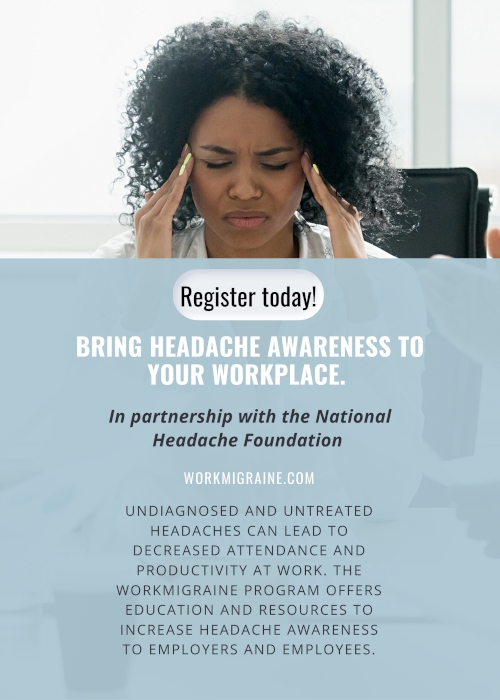
Migraine can have a major impact at work. Bright lights, computer screens, noise, strong odors, long hours, skipped meals, and high stress can all make symptoms worse. Because migraine is often invisible, employees may feel embarrassed or afraid to ask for support.
Workplace accommodations can make a meaningful difference. Helpful changes may include reducing harsh lighting, allowing screen filters or anti-glare monitors, offering flexible scheduling, allowing remote work when possible, providing access to a quiet dark space during an attack, reducing exposure to strong smells, allowing breaks for food and hydration, and supporting employees who need medical appointments.
Employers benefit when they take migraine seriously. Supportive workplaces can reduce presenteeism, absenteeism, stigma, and unnecessary suffering. A compassionate workplace culture allows employees to seek care, manage symptoms, and remain productive without feeling judged.
The Emotional Impact of Migraine
Migraine does not only affect the body. It can affect a person’s emotional well-being. People with frequent migraine may worry about when the next attack will happen. They may cancel plans, miss family events, fall behind at work, or feel guilty for needing rest. Over time, this can lead to isolation, frustration, anxiety, or depression.
The emotional burden is often made worse when others dismiss the condition. Statements like “Everyone gets headaches,” “You looked fine yesterday,” or “You just need to toughen up” can be deeply harmful. Migraine Awareness Month reminds us that compassion matters. Listening matters. Believing people matters.
Support from family, friends, coworkers, employers, and healthcare providers can make a real difference. Sometimes the most powerful thing you can say is, “I believe you. How can I help?”
When to Seek Medical Care
Anyone who experiences recurring headaches or migraine-like symptoms should talk with a healthcare professional. A proper diagnosis can help rule out other conditions and open the door to better treatment.
Emergency care is needed for a sudden, severe headache that feels like the worst headache of your life, a headache after a head injury, headache with fever or stiff neck, confusion, seizure, fainting, double vision, weakness, numbness, trouble speaking, or symptoms that feel very different from your usual migraine pattern. New aura-like symptoms should also be evaluated, especially if they have never been diagnosed before.
People should also seek medical advice if headaches are becoming more frequent, more severe, harder to treat, interfering with work or daily activities, or requiring frequent medication. Overuse of pain medication can sometimes make headaches worse over time, so a healthcare provider can help create a safer and more effective treatment plan.

How to Support Migraine Awareness Month
Migraine Awareness Month is an opportunity for everyone to help create change. You do not have to be a medical expert to make a difference.
You can learn the signs and symptoms of migraine.
You can stop calling migraine “just a headache.”
You can share accurate information.
You can encourage someone to seek care.
You can support migraine-friendly workplace policies.
You can listen without judgment.
You can advocate for better access to treatment.
You can participate in awareness events.
You can wear purple, the color commonly associated with migraine awareness.
You can share your story or amplify the stories of others.
Awareness leads to understanding. Understanding leads to compassion. Compassion leads to better care, better support, and better outcomes.
A Final Message for Migraine Awareness Month
Migraine is real. Migraine is disabling. Migraine is neurological. Migraine is often invisible, but the people living with it should never feel invisible.
This Migraine Awareness Month, let us move beyond outdated myths and make room for truth. Let us recognize the strength of those who live with migraine, the families who support them, the employers who accommodate them, and the healthcare professionals who help them find relief.
No one should have to suffer in silence. No one should have to prove their pain. No one should be dismissed because their disease cannot always be seen.
Migraine Awareness Month is a call to listen, learn, support, and advocate. Together, we can help build a world where migraine is understood, treatment is accessible, workplaces are compassionate, and every person living with migraine feels seen, heard, and supported.
What It Takes to Be the GOAT: The Impact of Mental Hygiene
Monday, February 2nd, 2026
Greatness is often explained through genetics, work ethic, or sacrifice.
That story is incomplete.
What separates the Greatest of All Time (GOAT) from the merely elite is not just physical mastery or technical skill—it is mental hygiene: the ongoing discipline of tending to one’s inner environment with the same rigor applied to physical training.
That has always been true.
What’s changed is this:
In the Age of AI, mental hygiene is no longer just for the GOATs.
It is becoming essential for anyone who wants to perform well or live a fulfilled life without being quietly overtaken by speed, noise, and feedback.
No modern athlete illustrates this more clearly than Simone Biles.

Simone Biles: Redefining Greatness Through Mental Hygiene
Biles has been dubbed the GOAT in gymnastics for her consistency, longevity, and, perhaps most importantly, for her ability to push the boundaries in her sport.
Simone Biles didn’t just dominate gymnastics, she redefined the psychological contract of excellence.
GOAT status achieved.
When she stepped away from competition at the Tokyo Olympics, many framed it as fragility. In reality, it was elite mental hygiene in action.
She recognized something fundamental:
- The body executes what the mind permits
- Precision sports punish even microscopic cognitive dissonance
- Ignoring internal signals is not toughness—it is negligence
Her decision was not avoidance.
It was maintenance.
Biles has spoken openly about:
- Regular therapy. Mental hygiene requires focused attention.
- Psychological safety as a prerequisite for peak performance. Genius requires vulnerability.
- Differentiating identity from output. Ever feel like a human-doing and not a human being?
- Treating mental clarity as non-negotiable infrastructure
That is not a weakness.
That is GOAT-level systems thinking.
Mental Hygiene: The Hidden Operating System of Greatness
Mental hygiene is not “positive thinking.”
It is not motivation.
It is not confidence.
It is the deliberate care of the meaning-making machinery that determines:
- Focus under pressure
- Decision-making at speed
- Recovery after failure
- The ability to sustain excellence without collapse
Every GOAT eventually learns the same lesson:
You do not rise to the level of your talent.
You fall to the level of your unexamined inner architecture.
Simone Biles simply learned it earlier—and publicly.
Other GOATs Who Built Mental Hygiene Regimes
Simone is not an anomaly. She is part of a quiet lineage.
Across eras and disciplines, the greatest performers didn’t just train their bodies—they trained their inner operating systems.
- Michael Jordan
Used visualization, emotional regulation, and ruthless narrative control. His edge was not rage—it was meaning discipline. - Serena Williams
Worked extensively with sports psychologists, breathwork, and emotional self-regulation to sustain dominance across decades. - Novak Djokovic
Treats meditation, breath control, dietary clarity, and cognitive reframing as performance fundamentals—not accessories. - Kobe Bryant
The “Mamba Mentality” was a structured internal practice: attention control, narrative precision, and emotional hygiene under pressure. - Tom Brady
Integrated mindfulness, body awareness, and identity separation to sustain elite performance into his mid-40s.
The pattern is unmistakable.
Why This Conversation Matters Now
These GOATs were performing at 100% in environments that demanded everything from them.
But here’s the shift:
You no longer need to be an elite athlete to experience elite-level cognitive pressure.
We are now living in a world where:
- Information never stops
- Comparison is algorithmic
- Feedback is instant
- Identity is continuously mirrored back to us
- Attention is fragmented by design
Some people reading this want to perform at the highest level of their field.
Others simply want to live a grounded, fulfilled life without feeling mentally hijacked.
In both cases, the challenge and opportunity is the same:
The modern mind is no longer stressed by effort alone —
it is stressed by the velocity of change.
The speed at which meaning, judgment, and possibility arrive now exceeds the nervous system’s natural capacity to integrate them without intentional hygiene.
It took roughly 10,000 years to go from writing to the printing press, but only 500 more to get to email. The number of happenings in our time compared to those of our ancestors is unprecedented.
What used to take 10,000 years, now takes 1,000.
Novelty that used to manifest inside 100 years now appears in 10.
Futurists and technologists have used metaphors and heuristic models, like Buckminster Fuller’s ‘knowledge doubling curve’, to describe how human knowledge and digital information are accelerating at unprecedented rates. The Age of AI changes the very way these models measure our experience.
This is why mental hygiene is no longer optional.
It is becoming infrastructure.
Mental Hygiene in the Age of AI

Artificial intelligence is not just changing how we work.
It is changing how meaning forms. We are living in a society that programs us through 90-second AI-augmented video clips. A world where we need a natural discernment in everything we see. Our cognitive load is shifting. We have to learn now to orient and navigate in a busy, noisy world.
The illiteracy of our age isn’t about being able to read or write. It’s about whether we can begin to orient in a world our old programming wasn’t designed to operate from. Can we learn, unlearn, and then relearn again?
When:
- Narratives update instantly. The Velocity of change is passing a tipping point.
- Feedback loops never close. News is global and 24/7, all focused on suffering. Suffering sells
- Identity becomes data-reflected
- Thought accelerates without pause
Unexamined inner patterns don’t disappear.
They accelerate.
Old assumptions become faster loops.
Unresolved meaning gets louder.
Automatic reactions begin to feel like “who we are.”
People don’t burn out because they’re weak.
They burn out because they are running outdated inner software at modern speeds.
The GOATs sensed this intuitively.
Most people are only now beginning to feel it.
From Performance Hygiene to Personal Hygiene
Elite performers treat mental hygiene the way pilots treat instruments:
- Not as inspiration
- Not as self-help
- But as navigation
For some, this is about winning medals.
For others, it’s about:
- Not losing themselves
- Not living in chronic reactivity
- Not confusing pressure with purpose
- Reclaiming agency and purpose to the “I am”.
The principle is universal:
If you don’t tend the inner environment,
the environment will tend you.
Introducing Turning Within
This is where Turning Within fits—not as a philosophy, but as practice. (Learn More Here)
Turning Within is a personal mental hygiene discipline designed to help practitioners:
- Recalibrate their inner orientation
- Examine and update deep conscious patterns
- Interrupt and recalibrate automatic feedback loops in a high-speed world
- Integrate a deeper, more conscious, purposeful version of self in all facets of life.
In a modern mind moving at light speed, meaning doesn’t just form—it feeds back on itself:
- Meaning drives narrative.
- Narrative flows in story form.
- Story forms and is informed by belief.
- Perception reinforces the original thought.
Turning Within gives people a way to:
- Slow that loop down
- See it clearly
- Change it deliberately
Not to escape reality.
But to engage it with agency.
Just as physical hygiene prevents illness,
mental hygiene prevents distortion.
And distortion scales fast now.
The Pattern Is the Point
Across disciplines, eras, and personalities, the pattern is consistent:
- Physical training builds capacity
- Technical training builds execution
- Mental hygiene sustains and creates conscious coherence
GOATs don’t just train harder.
They maintain their inner environment so pressure doesn’t distort perception, identity, or choice.
Simone Biles didn’t step back from greatness.
She demonstrated it.
The Real Question
The real question is no longer:
“Do you have what it takes to be the GOAT?”
It is:
“Are you willing to maintain your mind with the same seriousness you maintain your life?”
Because talent without mental hygiene doesn’t fail loudly.
It fails slowly—through burnout, distortion, and loss of agency.
In the Age of AI, that slow failure happens faster. Equally, what used to be available for the few is now the experience of many. Greatness, real greatness… and a fulfilled life now share the same requirement:
Mental hygiene.

COVID-19: What We Need to Know
Saturday, March 14th, 2020
The world has been affected by this coronavirus outbreak in a way that none of us expected a few weeks ago. With the widespread reach of the media and social networks, we have the double-edged sword of a surplus of information. It can be difficult to wade through it all and make sense of what it means. There are two extreme ends of the spectrum, oscillating between extreme panic to an almost blase attitude. There is some real cause for concern, but we’d like to help the situation by compiling some helpful facts and tips for how to handle our current situation.

Preventing the Spread of Disease
The disease has been found to spread most easily from close contact (within 6 feet) from person to person. The transfer of the virus can occur from unprotected coughing or sneezing. The CDC has been extremely clear in describing the measures we can all take to prevent the spread of this highly contagious virus.
- Wash hands frequently, especially after using the bathroom, coughing or sneezing, touching any potentially contaminated surfaces.
- Keep your unwashed hands away from your face where germs can obtain easy entry into your body.
- Stay home when you are sick.
- Keep away from people who are infected with the virus.
- Put distance between yourself and large groups of people if there is a spread in your community.
- Wear a facemask ONLY if you are sick or caring for a sick person who may be unable to wear one.
- Clean and disinfect frequently touched surfaces.

As employers, how can we keep our workplaces healthy?
- Encourage employees to stay home when sick by providing flexible sick leave policies.
- Enable as much work to be done remotely as possible during community outbreaks.
- Separate sick employees who may become sick during the workday.
- Encourage routine hand washing.
- Perform thorough routine cleaning of frequently touched surfaces.
- Educate employees on symptoms or coronavirus.
Symptoms of Coronavirus
The coronavirus is a respiratory illness exhibiting the following symptoms. Keep in mind that people may respond to the virus in different ways. These symptoms may appear up to 14 days after exposure:
- Fever
- Cough
- Shortness of breath
Most cases of the virus have been mild and recoverable. However, there are some who are at increased risk for the most severe cases, potentially becoming fatal. Those at high risk include the elderly and those with preexisting conditions such as heart disease, diabetes, and lung disease. If you or someone close to you fit into the high-risk category, take extra precautions.
If you do exhibit symptoms don’t go to the doctor. Call your doctor and describe your symptoms and possible exposure to the illness. They can advise you if you need to be tested and tell you what your next steps should be.

Be a Kind Human
Remember that we are all in this together. Even if you are not at a high-risk for infection, you may unknowingly be in close contact with people who are. Consider the people around you. Take all the precautions advised by the CDC to prevent or lessen a widespread outbreak in your area.
Be considerate when stocking up on supplies and only purchase what you need. Leave some for others rather than overbuying out of panic or fear.
Keeping Anxiety at Bay
In order to keep anxiety at bay, it may be best to limit your exposure to social media outlets. Protect your mental health by keeping things light, talking to your loved ones and staying focused on the positive. Even though this virus isn’t well known, much progress has been made already. The mass cancellations are for our safety and prevention and should be comforting more than inciting fear. It’s a means of stopping the spread of the virus so that it stays under control.
For much more specific information on the coronavirus and how to stay healthy, especially as businesses and employers, visit the official CDC website.
Cervical Cancer is Preventable
Tuesday, November 26th, 2019
January is Cervical Health Awareness month to raise awareness about HPV vaccination and prevent cervical cancer. Currently, 13,000 women in America have cervical cancer. Millions more have the HPV virus, which is the most common cause of cervical cancer. The critical thing to note this month is that deaths due to cervical cancer are preventable.

What is HPV?
Human Papillomavirus Infection, commonly referred to as HPV, is a prevalent virus. Nearly 80 million people in the United States are infected. This virus can be spread through sexual activity. Since many who are infected never exhibit any symptoms, it can be easily spread without realizing. This is why regular exams are so important.
Mild cases of HPV can produce genital warts, while extreme cases can lead to Cervical Cancer. There is no treatment available for HPV, which is why the vaccine is so important. Prevention is possible.

The HPV Vaccine
Doctors recommend that both boys and girls receive the HPV vaccine beginning at age 11 or 12. Receiving the vaccine at such an early age ensures a better and stronger immune response. Usually, only 2 doses are necessary for children under age 15. In adulthood, it may take up to 3 doses of the vaccine to achieve the same result. Individuals can receive the vaccine through age 45.
Beginning at age 21, women should receive a pap screening every year. Women over 30 should receive both a pap test and HPV test regularly. Most insurance plans cover cervical cancer screenings, so all preventative care should come at no additional cost to the patient. This makes it even easier to prevent Cervical Cancer.

Early Detection is Key
Regular cervical screenings can detect any abnormal changes in cells before they become cancerous. So even though there is no treatment, prevention is very simple. It’s simple because all it takes is to keep up with your regular well check-ups.
Help us spread the word and promote awareness about Cervical Cancer prevention. The tragedy of deaths by Cervical Cancer can be prevented with regular screenings and follow up care. Visit our Wellness Observance Calendar for resources and information to help us spread awareness.